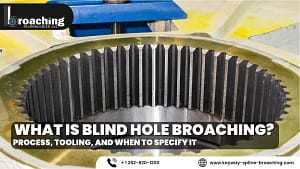
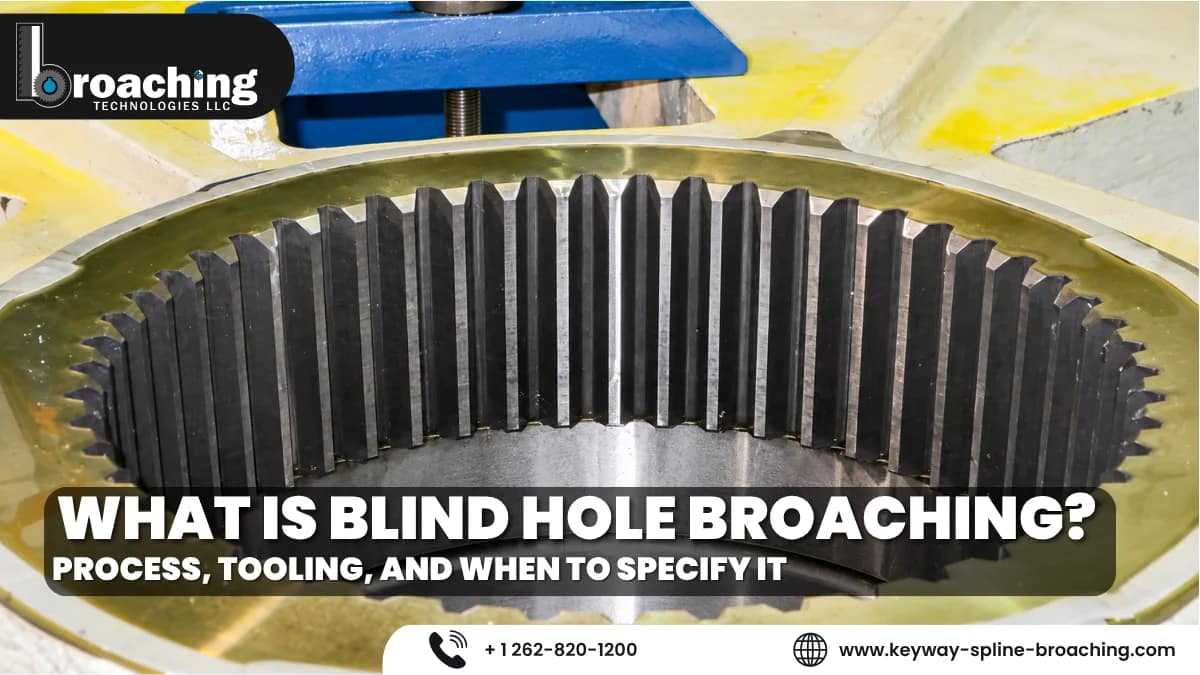
Blind hole broaching is a machining process. It cuts keyways, splines, slots, and other profiles inside a bore that doesn’t go all the way through the workpiece. The tool enters from one end, machines the feature to a precise depth, and retracts — without ever exiting the opposite side of the part.
That single constraint changes everything about how the process works. In standard through hole broaching, chips clear naturally through the open end. The tool moves along a continuous path, and the depth is set by the bore length. In blind hole broaching, none of that applies. Chip evacuation, tool shape, depth control, and machine strength require different engineering than through-bore applications. This guide explains blind hole broaching. It looks at the challenges that make it trickier than regular broaching. You’ll find details on common uses, tooling and equipment needs, and tips on when to choose this process for your part design.
Key Takeaways
- Blind hole broaching machines create internal features in closed-end bores. Since the broach can’t exit the workpiece, they need special tools and exact depth control.
- Chip evacuation is the main technical challenge. Without an exit path, chips must be managed in the bore using tool geometry, relief features, and controlled cutting sequences.
- Vertical slotting machines provide advantages over horizontal broaching systems for blind applications because of their controlled stroke, rigid alignment, and gravity-assisted chip clearance.
- Blind keyways and blind splines are the most common features made through blind broaching. They are often found in hubs, gears, couplings, and power transmission parts. These designs keep the back face intact.
- Part designers should add relief grooves or undercuts at the bottom of blind bores when they can. This helps with chip clearance and improves broach accuracy.
- Not every closed bore feature needs blind hole broaching. Alternatives like EDM, CNC milling, or wire cutting might be better based on geometry, volume, tolerance, and cost.
Table of Contents
- How Blind Hole Broaching Works
- What Makes Blind Hole Broaching Difficult
- Common Applications: Blind Keyways and Blind Splines
- Tooling and Equipment Requirements
- Blind Hole Broaching vs. Through Hole Broaching
- Materials Commonly Blind Hole Broached
- When to Specify Blind Hole Broaching — and When to Consider Alternatives
- Frequently Asked Questions
How Blind Hole Broaching Works
In a broaching operation, a toothed cutting tool removes material step by step. Each tooth is a bit higher than the last, which allows one pass to create the finished profile. In through hole broaching, the broach enters the bore, cuts through the full length, and exits the other side.
Blind hole broaching uses the same cutting principle, but the tool path ends inside the workpiece. The broach, or the reciprocating cutting tool in slotting applications, goes into the bore. It machines the internal feature until it reaches a set stopping point, then pulls back along the same path. The critical difference is that there is no exit. Everything that happens during the cut—chip formation, heat, and cutting force—must be controlled in a closed space.
A typical blind hole broaching sequence involves:
- Fixturing the workpiece with the bore opening facing the tool.
- Aligning the tool to the bore centerline and the desired angular position.
- Advancing the tool into the bore at a controlled feed rate.
- Cutting to the programmed depth, with tool geometry and stroke calibrated to the required profile.
- Retracting the tool without contacting the freshly machined surface.
- Repeating with progressive tooling or additional passes until the feature reaches final dimensions.
In slotting-based blind broaching, the tool moves up and down through the bore. It does this in successive strokes, with each stroke going a bit deeper. This lets the operator control depth, cutting force, and chip load per stroke. That’s why vertical slotting machines are popular for this task.
What Makes Blind Hole Broaching Difficult
Blind hole broaching is considered one of the more challenging internal machining processes. The difficulty comes from three interconnected constraints.
Chip Evacuation
In through hole broaching, chips exit the bore naturally as the tool passes through. In a blind bore, chips have nowhere to go. They accumulate at the bottom of the cut, pack between tool teeth, and — if not managed — create back-pressure against the cutting edge.
Packed chips lead to problems like dimensional inaccuracy, rough surfaces, faster tool wear, and, in severe cases, tool breakage or damage to the workpiece. To manage this, you need tool geometry that breaks and compresses chips into small pieces. Also, include relief features in the part, like grooves, undercuts, or cross-holes at the bore’s bottom. Finally, plan a cutting sequence that allows for chip clearance between passes.
Depth Control
The broach must stop at exactly the right point inside the bore. Overshoot damages the part. Undershoot leaves the feature incomplete. In a through bore, depth is self-limiting — the tool passes through. In a blind bore, the machine must control the stopping point to within thousandths of an inch. This needs strict, repeatable control of machine strokes. NC-controlled vertical machines are often preferred for blind applications. This is because they outperform manual or horizontal setups.
Tool Retraction
After the cut, the tool must retract through the bore without dragging across the finished surface. Contact during retraction damages the surface finish and compromises dimensional accuracy. This needs tool designs with relief angles for the return stroke. It also requires machines that have an electronic tool lift. This lift disengages the cutting edge before retraction starts.
Blind hole broaching requires special tools and equipment because of three key challenges: chip removal, depth control, and clean retraction. General-purpose broaching machines meant for through-bore work usually can’t manage them.
Common Applications: Blind Keyways and Blind Splines
Blind hole broaching can produce a range of internal forms, but the most common applications are blind keyways and blind splines.
Blind Keyways
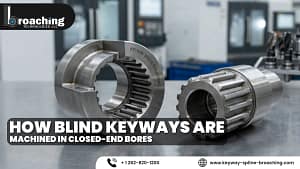
A blind keyway is an internal rectangular slot that stops short of the part’s back face. It accepts a key that locks a shaft and hub together for torque transmission. Blind keyways are used when the back face needs to stay whole. This is important for structural strength, sealing, or function. Common parts are gear hubs, pulleys, couplings, sprockets, and motor housings. An open-ended keyway can weaken these parts or expose the internal assembly.
Blind Splines
A blind spline is a multi-tooth shape that’s internal. It can be involute, straight-sided, or serrated, and it ends inside the bore. Splines spread torque over several teeth instead of just one key. This makes them better for handling higher loads and ensures more precise alignment.
Blind splines are found in power transmission assemblies, automotive drivetrains, aerospace actuators, hydraulic pump housings, and industrial machinery. They stop before reaching a shoulder, seal surface, or structural wall. Both features require the same chip evacuation, depth control, and retraction precision noted earlier. Splines are complex. Their multi-tooth profile needs steady concentricity and accurate tooth form for each tooth at the set stopping depth.
Tooling and Equipment Requirements
Tool Design
Blind hole broaching tools differ from standard through broaches in several important ways. Tooth geometry must account for chip compression within the bore rather than chip clearance through an exit. Progressive tooth loading means each tooth takes a small, controlled cut. This approach limits the cutting force with each stroke and reduces the amount of chips produced at once.
Relief angles on the tool allow clean retraction. Surface coatings like TiN or TiAlN help control heat in closed bores. In these areas, coolant can’t reach as easily, so heat builds up quicker than in open cuts. Custom tooling is typical for blind work. Standard off-the-shelf broaches are made for through-bore use. They usually don’t have the right shape for managing chips in blind holes or for stopping at controlled depths.
Equipment
Vertical slotting machines are the top choice for blind hole broaching. This orientation tackles the three main challenges effectively. In a horizontal broaching system, the tool travels laterally through the bore. This works well for through holes, where gravity assists chip clearance and the tool exits freely. In a blind bore, a horizontal setup makes things tough for the operator. Chips settle in the cutting zone instead of dropping away. Also, controlling lateral tool retraction over the finished surface is trickier.
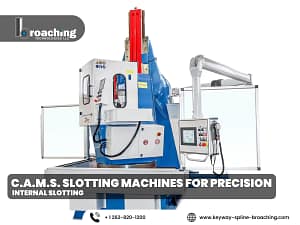
Vertical slotting machines orient the cut so the tool reciprocates vertically. Gravity assists chip fall-away from the cutting zone during retraction. NC-programmed stroke control provides precise, repeatable depth stops. The electronic tool lift stops the cutting edge before it returns, protecting the machined surface. C.A.M.S. Vertical slotting machines have been engineered in Italy since 1975. They are available through Broaching Technologies, the exclusive North American dealer. These machines are used for blind hole broaching in various industries. Their adjustable NC-controlled axes, programmable stroke control, and high rigidity under steady cutting loads make them ideal for blind internal work.
Blind Hole Broaching vs. Through Hole Broaching
Choosing the right broaching method depends on the part’s shape and its functional needs.
| Criteria | Blind Hole Broaching | Through Hole Broaching |
| Bore type | Closed at one end | Open at both ends |
| Tool path | Enters and retracts from the same side | Passes completely through |
| Chip evacuation | Chips managed internally; relief features required | Chips exit through the opposite end |
| Depth control | NC-controlled stopping point; critical | Self-limiting (bore length) |
| Tooling | Specialized blind broach geometry; typically custom | Standard through broaches available |
| Complexity | Higher | Moderate |
| Typical applications | Blind keyways, closed-bore splines, sealed housings | Through keyways, open splines, gears |
| Relative cost | Higher (tooling + setup + machine requirements) | Lower |
If the part design permits a through bore, through hole broaching is almost always simpler, faster, and less expensive. Blind hole broaching is specified when the design requires the bore to remain closed — for structural, sealing, alignment, or functional reasons that make a through bore unacceptable.
For a detailed technical comparison of blind and through keyway geometry, tolerances, and surface finish considerations, see Blind vs. Through Keyway Broaching: Technical Differences.
Materials Commonly Blind Hole Broached
Blind hole broaching is performed across a range of engineering materials, but material selection directly affects chip behavior, tool life, and whether the part geometry is practically broachable in a blind configuration.
Carbon and alloy steels are the most common substrates for keyway and spline broaching. They offer predictable chip formation and good tool life in blind applications.
Stainless steels are machinable but more demanding on tooling. Work-hardening tendencies and heat buildup in the closed bore accelerate tool wear and require careful speed and feed management.
Aluminum alloys machine easily but require attention to chip packing. Aluminum produces long, stringy chips that jam in blind bores if relief geometry and chip-breaking strategy are not addressed in the tooling design.
Bronze and brass are common in bushings and bearings and are generally favorable for blind broaching due to good chip-breaking characteristics.
High-strength alloys such as Inconel and titanium are the most challenging substrates. High cutting forces, rapid tool wear, and significant heat generation make blind features in these materials a specialized operation requiring rigid equipment, conservative feed rates, and carefully designed tooling.
Harder materials with poor chip-breaking characteristics compound the chip evacuation problem — which is already the most difficult aspect of blind hole broaching.
When to Specify Blind Hole Broaching — and When to Consider Alternatives
Blind hole broaching is the right specification when the bore must remain closed at one end for structural, sealing, or functional reasons, when the internal feature requires tight tolerances and high repeatability across production volume, when the profile is a standard keyway or spline form that broaching produces efficiently, and when production volume justifies the tooling investment.
Consider alternatives when:
The feature is extremely deep relative to bore diameter. Depth-to-diameter ratios beyond practical limits make blind broaching increasingly difficult and expensive. EDM or wire cutting may be more practical for extreme aspect ratios.
The geometry is non-standard or highly complex. Irregular profiles that don’t match standard broach tooth forms may be better suited to CNC milling or EDM.
Volume is very low. Custom blind broach tooling is expensive. For a single part or prototype, CNC milling or EDM may be more cost-effective even with a longer cycle time.
The part material is extremely hard or exotic. Some nickel-based superalloys and hardened steels above approximately 45 HRC push blind broaching to its practical limits. EDM handles these materials without cutting-force concerns.
The design allows a through bore. If the closed end is not functionally necessary, switching to a through bore simplifies the operation dramatically and reduces cost.
The decision often comes down to volume, tolerance, and whether the closed-end bore is a hard design constraint or an inherited feature that could be redesigned. Engineers specifying blind features should involve the broaching provider early — relief groove placement, bore depth, and material selection all affect whether the feature is practically broachable and what it will cost.
Evaluate Your Blind Hole Broaching Requirements
If your part design calls for internal keyways, splines, or other profiles in a closed-end bore, the right approach starts with reviewing geometry, depth, material, and tolerance requirements before committing to a process.
Send your part drawing to Broaching Technologies and our team will evaluate whether blind hole broaching is the most effective solution, recommend tooling and process parameters, and provide a quote. For manufacturers considering bringing blind work in-house, we can also discuss C.A.M.S. vertical slotting machine options matched to your production requirements.
Frequently Asked Questions
Does a blind keyway always require blind hole broaching?
Not necessarily. A keyway is considered “blind” when it stops inside the bore rather than extending through the full length. But if the bore itself passes through the workpiece, the keyway can sometimes be machined using standard through-bore techniques with a modified tool path — even though the keyway feature terminates before the end of the bore. The requirement for blind hole broaching specifically applies when the bore itself is closed at one end.
Can part design reduce the difficulty of blind hole broaching?
Significantly. Including a relief groove or undercut at the bottom of the bore gives chips space to break away and reduces back-pressure on the tool. Even a narrow groove — as small as 0.050″–0.075″ wide, with a diameter slightly larger than the feature’s major diameter — improves chip clearance, tool life, and dimensional accuracy. Designers should also evaluate whether bore depth and feature depth allow adequate stroke clearance for the machine and tooling being used.
How do blind hole broaching tolerances compare to through hole tolerances?
Blind hole broaching achieves tight, repeatable tolerances — in many applications within +0.0005″/-0.0000″ — but tolerances are generally harder to hold in blind bores than in through bores. Heat accumulates in the closed pocket, chips affect cutting consistency, and the tool has no exit reference. Material, depth, bore diameter, tooling condition, and machine rigidity all influence achievable tolerance in blind applications.
Is blind hole broaching always more expensive than through hole broaching?
Typically, yes. Custom tooling, more complex machine setup, lower feed rates, and additional process controls add cost. The cost gap narrows at higher production volumes where the tooling investment amortizes across more parts, but the per-part cost for blind work will generally exceed through-bore work on equivalent geometry.