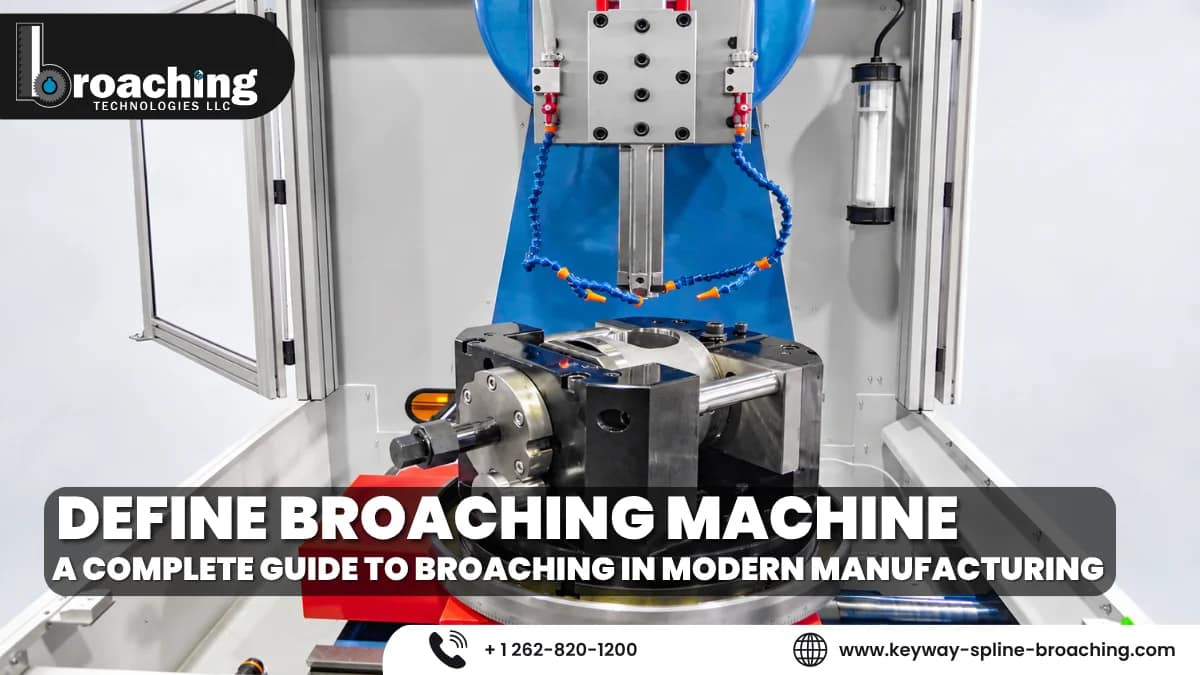
Machining processes quietly shape parts in nearly every vehicle, appliance, and industrial system. However, many people outside manufacturing don’t fully understand them. Broaching is one of them. If you want to learn about define broaching machine or what broaching is, check out Keyway Spline Broaching. They have all the information you need and can help you compare it to other metal cutting methods. For a reliable broaching machine manufacturer near Menomonee Falls, Wisconsin, choose Keyway Spline Broaching. They are trusted for broach machine manufacturing.
What Is a Broaching Machine? The Full Definition
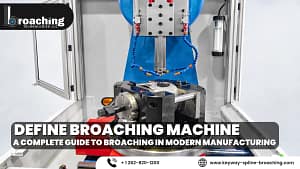
Define broaching machine is easy once you grasp its cutting tool. A broaching machine is a tool that uses a multi-toothed cutter called a broach. It removes material from a workpiece in one smooth, progressive pass. Each tooth on the broach is a bit larger than the last, allowing the tool to carve the finished profile as it moves through or across the part.
The progressive cutting action of the broach tool ensures exceptional efficiency. Broaching is different from milling or grinding. It achieves the final shape in one stroke, while the others need several passes. The term “broached” describes a workpiece whose profile has been formed through this method. Broaching creates a precisely shaped internal or external feature without extra finishing steps.
In manufacturing, “broach” also refers to the cutting tool itself. The broach tool is made from high-speed steel or carbide. It is built to tight tolerances. This design helps it maintain its shape over thousands of production cycles. Essentially, a broach is a hardened, serrated cutter that shapes metal with remarkable speed and repeatability.
What Is the Broaching Process?
The broaching process is a precision metal-cutting operation in which a specially designed multi-toothed tool the broach is passed through or across a workpiece to remove material and produce a finished profile in a single, uninterrupted stroke. Unlike turning or milling, where the tool takes multiple passes to approach the final dimension, broaching achieves the target geometry in one controlled movement. This makes it one of the fastest and most accurate methods available in modern manufacturing.
The process begins with the workpiece clamped firmly in a holding fixture on the broaching machine. Once the part is secured, the broach is aligned with the starting point either a pre-drilled pilot hole for internal profiles or the surface of the part for external operations. The machine then drives the broach through or across the workpiece using hydraulic or mechanical force. As each successive tooth engages the material, it removes a thin, consistent chip and leaves a slightly more refined surface than the tooth before it. By the time the final tooth clears the part, the profile is complete, dimensionally accurate, and ready for use.
What sets the broaching process apart from most other machining methods is its consistency. A well-maintained broach, properly fitted and matched to the right machine, delivers the same result on part number one as it does on part number fifty thousand. That level of repeatability — combined with the speed of a single-pass operation — is exactly why manufacturers across automotive, aerospace, and industrial sectors rely on broaching as a core production process rather than a supplementary one.
Understanding the Broaching Process: How It Works
The broaching process begins with the workpiece secured in a holding fixture. The broach, be it a push, pull, or rotary type, is pushed through or across the part by the machine’s ram or spindle. As the broaching tool moves forward, its teeth touch the metal surface one by one. Each tooth cuts a thin chip until they achieve the final profile.
This sequential cutting action is what makes broaching in machining so precise. The load spreads over many cutting edges instead of one spot. This cuts down heat buildup, reduces deflection, and helps the tool last longer. Broaching is a process that achieves high efficiency. A typical internal broach can complete a pass through a steel hub in a few seconds.
A key difference in broaching is between pull broaching and push broaching. In pull broaching, the machine draws the broach through the workpiece from one end to the other. This arrangement handles longer broaches better because tension keeps the tool aligned. Push broaching presses the tool through the workpiece. It’s usually for shorter broaches that make lighter cuts. Knowing the difference between pull and push broach operations helps engineers choose the right setup for each shape and material.
Broaching tools are made to tight tolerances. They must match the workpiece material and the target profile carefully. In hard broaching, operators use coated or carbide tools. These tools cut hardened steel or heat-treated alloys and help manage wear. Soft broaching addresses ductile materials like aluminum or mild steel, where cycle times are shorter and tool life is naturally longer.
Types of Broaching Machines and Their Applications
To define broaching machine, you need to know its different configurations. Each one serves a specific manufacturing purpose.
Vertical Broaching Machine
The vertical broaching machine is the most common configuration in production environments. It drives the broach tool on a vertical axis — either upward or downward — through the workpiece. Vertical broaching is compact and quick. It’s ideal for making internal shapes like keyways, splines, square holes, and hexagonal bores. Its relatively small footprint makes it a practical choice for high-volume production environments.
Horizontal Broaching Machine
The horizontal broaching machine runs on a horizontal axis. Horizontal Broach can easily handle longer broaches and heavier work pieces. This setup is common in automotive and heavy equipment manufacturing. It’s used when large surfaces need cutting or when part shapes require a longer stroke. Horizontal broaching is also preferred when broach tooling length exceeds what a vertical configuration can safely handle.
CNC Broaching
CNC broaching has significantly modernised the process by integrating tools and systems into automated production cells. This setup lets you control every detail of each stroke. So, CNC capabilities are key for custom broaching of complex shapes. These systems ensure precision across thousands of parts, giving the high consistency needed for modern manufacturing standards.
Using rotary broaching tools on a turning centre allows shops without standalone machines to do key broaching, hex socket forming, and square profile cutting in the same setup as their turning tasks.
Different Types of Broaches
Just as define broaching machine come in multiple configurations, the broaches themselves are designed in a variety of forms each suited to a specific profile, workpiece geometry, or production scenario. Choosing the correct broach type is as important as choosing the right machine.
Pull Broach
The pull broach is the most common type found in production environments. It is pulled through the workpiece by the machine, keeping the tool under tension throughout the entire stroke. This design accommodates longer tool bodies with more cutting teeth, enabling finer incremental cuts and superior surface finishes. Pull broaches are the standard choice for keyways, splines, and round internal profiles in through-bored workpieces.
Push Broach
The push broach is pressed through the workpiece under compressive force rather than being drawn. Because it must be short enough to resist buckling, it is reserved for lighter, shorter cuts — external chamfering, light internal sizing, or short-stroke surface operations. Push broaches are simpler in construction and lower in cost than pull broaches, making them a practical choice for less demanding applications.
Keyway Broach
The keyway broach is an internal broach designed specifically to cut a rectangular slot — the keyway — along the inner bore of a gear, pulley, or hub. It is one of the most frequently ordered broach types in general manufacturing because keyways are fundamental to power transmission components. A bushing guide is typically used alongside the keyway broach to maintain alignment through the bore during the cut.
Spline Broach
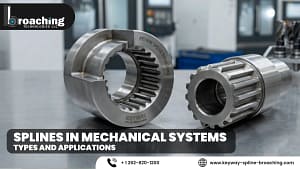
The spline broach cuts multiple equally spaced internal grooves in a single pass to produce a splined bore that can engage and transmit torque with a mating shaft. Spline broaches are essential in automotive transmissions, hydraulic motors, and any drivetrain application where a single keyway cannot handle the required load. The precision of a splined connection depends entirely on the accuracy of the broach geometry.
Surface Broach
The surface broach operates externally, traveling across the flat or contoured outer surface of a workpiece to produce precise faces, slots, or contoured profiles. In high-volume production, surface broaches often machine multiple flat surfaces simultaneously in a single pass, significantly reducing setup time and improving throughput on parts like engine blocks and housing components.
Pot Broach
A pot broach is a stationary tool through which the workpiece is moved rather than the other way around. The broach is fixed inside a cylindrical housing — the pot — and the part is pushed or pulled through it. This configuration is used primarily for external spline forming and gear tooth machining, particularly on parts where the workpiece geometry makes it more practical to move the part than to drive the tool.
Rotary Broaching Machine and Rotary Broach Tools
The rotary broaching is one of the elegant solutions for broaching. A rotary broach, also known as a wobble broach, is a cutter. It can be single-tooth or multi-form. It’s mounted at a precise one-degree offset in a rotary broach tool holder. As the spindle turns, the tool wobbles against the workpiece. This creates a non-round shape. For example, it can form a hex broach for socket heads, a square broach for square drives, or a hexagon broach for fastener pockets. Rotary broaches are popular in lathes and machining centres. They create polygonal profiles with ease. They do this without a special broaching machine, using the tools already on the shop floor. Rotary hex broach tools and square hole broach cutters are popular in production today.
Internal vs. External Broaching: Understanding Both Sides of the Process
When people think of broaching, they imagine a tool pulled through a hole. This idea is spot on for internal broaching. But the process covers far more ground than that. Understanding the differences between interior and exterior broaching will help manufacturers select the best setup for each application.
Internal Broaching: Precision From the Inside Out
Internal broaching is the most common form of the process, and this is due to its effectiveness. It involves driving the broach through a pre-made hole in the workpiece. This creates a precise shape on the inside surface, such as a splined bore in a gear hub, an internal keyway in a pulley, or a hexagonal socket in a fastener. The broach is guided throughout the whole cut. This provides a clear benefit by balancing the cutting forces, keeping the tool aligned, and maintaining a consistent profile throughout high-volume production runs. Engineers also favour internal broaching for its surface finish quality. It consistently achieves tolerances precise enough to eliminate secondary grinding or finishing, saving time and cost downstream.
External Broaching: Shaping the Outside with Equal Precision
External broaching works differently. Instead of cutting inside a hole, the broach tool moves across or along the outer surface of the workpiece. This lets manufacturers make flat faces, curved edges, gear teeth, serrations, and complex shapes in one controlled pass. Surface broaching is the most common type of external broaching. It’s especially useful in high-volume production settings where many outer surfaces on a single component need machining at once. Engine blocks, turbine housings, and transmission cases are great examples of parts that benefit from surface broaching. Their flat mating faces need tight flatness tolerances and a smooth finish. This helps them fit well with nearby components.
What makes both internal and external broaching so valuable is the consistency they deliver once the setup is dialed in. The broach works by cutting from inside a bore or sweeping across an outer face. Its tool geometry handles the task, so every part created shows the same shape, cycle after cycle, with almost no variation.
Why Work With a Specialist Broaching Machine Manufacturer
Choosing the right broach manufacturer is key when you need exact internal profiles, keyways, or custom shapes. Dedicated broaching companies provide deeper tooling expertise and better process optimisation than general machine shops. While some shops may offer broaching as an extra service, they lack the specialised knowledge and application engineering that dedicated firms have.
At Broaching Technologies, LLC, our Menomonee Falls, Wisconsin facility focuses on broaching manufacturing. We offer a range of broaching solutions that ensure precision, repeatability, and support for long production runs. This includes vertical and horizontal broaching machines, rotary broaching systems, CNC broaching setups, and custom broaching services. Our equipment and expertise can meet your toughest component needs. We support customers with broach sharpening machines and complete broach tooling packages. This includes rotary broach kit setups, choices for broach bits, and custom cutting broaches made to your specifications. Our broaching machine specialties are built around your application, not the other way around.
If you’re setting up your broaching process or growing an existing operation, our team is ready to help.
Contact Our Broaching Machine Specialists
If you need a dedicated broaching machine manufacturer, Keyway Spline Broaching can help. We have the engineering skills, machine capacity, and tooling knowledge for your next project. Our team provides precise manufacturing using vertical, horizontal, rotary, and CNC broaching platforms. From first-run custom broaching to long-term production contracts, we bring the same commitment to accuracy to every part we process.
Contact us today to discuss your application, request a quote, or ask our specialists about define broaching machine specialties, custom tooling, or broach sharpening support. We look forward to becoming your trusted partner in precision metalworking.
Frequently Asked Questions
What is a broaching machine and what is it used for?
A broaching machine is a tool that uses a multi-toothed broach cutter. It drives the cutter through or across a workpiece. This process creates precisely shaped profiles in just one pass. Common uses include keyways, splines, hexagonal sockets, square holes, and flat surfaces. These are found in industries like automotive, aerospace, and industrial equipment manufacturing.
What is the difference between push and pull broach?
The tool is pulled through the workpiece. This distributes cutting forces over the length of the tool, making it perfect for deeper cuts and longer broaches. Push broaching presses the tool through from one end, better suited for shorter broaches performing lighter material removal. The choice affects fixture design, machine configuration, and broach tooling dimensions.
How does a rotary broach work?
A rotary broach sits at a one-degree angle in a tool holder and spins as the spindle moves forward. The wobbling motion progressively cuts a polygonal profile such as a hex or square into the workpiece face. Rotary broaches can be used on standard lathes and machining centers, making broaching on a lathe accessible without a dedicated machine.
What does broaching mean in metalworking?
In metalworking, broaching is the process of removing material. It uses a serrated broach tool that cuts in a controlled way. This creates a specific profile. The broaching meaning in manufacturing centers on speed, dimensional accuracy, and the ability to hold tight tolerances across large production volumes.
What materials are compatible with broaching?
Broaching metal applications cover many types: mild steel, stainless steel, aluminium, brass, cast iron, and hardened alloys. Hard broaching requires coated cutting broaches and careful speed control, while soft broaching on ductile materials is faster and extends broach life considerably.
In automotive manufacturing, what is the purpose of broaching?
In automotive manufacturing, broaching machining cuts keyways in transmission gears. It also makes splined shafts. It shapes hexagonal valve-seat profiles and machine parts for brake drums and cylinder blocks. The process is fast and steady, making it perfect for the high demands of automotive production.