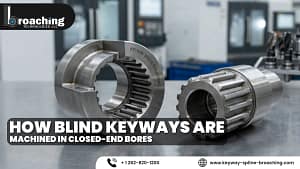
A drawing lands on your desk with a bore that’s closed at one end and a keyway that has to stop short of the bottom. You send it out for a keyway broaching quote, and the shop replies with a question instead of a price: is the bore open on the far side? It isn’t — and that one detail changes how the slot has to be cut, priced, and inspected.
Most internal keyways are produced by pushing or pulling a broach straight through the bore. A blind keyway takes that option off the table. When the slot has to end inside the part, the cutting tool has nowhere to exit and the chips have nowhere to fall, so the work shifts to a different process built around controlled vertical cutting. This guide explains how blind keyways are actually machined, the single design detail that causes the most fit problems, and what to have ready before you send a closed-end part out for quote.
Key takeaways
- A blind keyway stops inside the bore rather than running all the way through — either because the bore is closed at one end or because the slot has to terminate before the opening.
- Standard push or pull broaching needs a clear path for the tool and the chips, so blind keyways are cut mainly by vertical slotting.
- The far end of a blind keyway is never a crisp square corner; a relief undercut is usually needed so the mating key seats to full length.
- Chip clearance, tool rigidity, and precise depth control are what separate a clean blind keyway from a scrapped part.
- Material, tolerance, and exactly where the keyway stops all belong on the drawing before the job is quoted.
What this guide covers
- What makes a keyway “blind”
- Why standard broaching can’t finish the cut
- Vertical slotting, the primary method
- End relief: the detail that decides fit
- Clearing chips from a closed pocket
- Holding tolerance on width, depth, and position
- How the material changes the job
- When a blind keyway is the right call
- What to prepare before requesting a quote
- FAQs
Blind keyways are machined by vertical slotting rather than by conventional broaching. A single-point slotting tool strokes lengthwise along the keyway, shaves off a thin layer on each pass, and steps deeper until it reaches full depth — then stops at a controlled point inside the bore. Because the tool never has to pass through the part, it can cut a slot that terminates against a closed end, which a through-broach cannot do.
Blind Keyway Definition and Applications
A keyway is a rectangular slot cut into a bore so that a key can sit between the shaft and the hub — a gear, sprocket, pulley, or coupling — and carry torque from one to the other. A blind keyway is one that doesn’t run the full length of the bore. It ends somewhere inside the part.
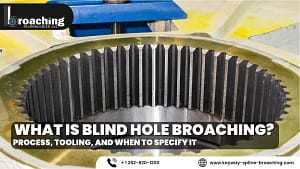
That happens in two common situations. The bore itself may be closed at one end, so there’s no through-hole for a tool to exit — a true blind hole. Or the bore may be open, but the keyway still has to stop short of the opening because a full-length slot would break into a sealing surface, a bearing seat, or an adjacent feature. Either way, the cut has to begin, reach depth, and end at a defined point inside the part.
A through keyway is a different problem. The bore is open at both ends, the tool passes completely through, and the slot runs the whole length. That open path is exactly what a broach depends on, and it’s exactly what a blind feature removes.
Why Standard Broaching Cannot Cut a Blind Keyway
Conventional keyway broaching is fast and repeatable, but it only works when the tool can travel all the way through the bore. A broach is a hardened bar carrying a row of teeth, each standing slightly taller than the one before it. The broach is pushed or pulled through the bore in a single pass — deeper keyways may take several passes with a shim added behind the broach — and each tooth removes a little more material until the slot reaches full depth as the last tooth clears the far side.
Three things break down when the bore is blind:
The tool has no exit. A broach is designed to pass completely through the work and come out the other side; against a closed end, it simply has nowhere to go.
The chips have no exit. During through-broaching, the material peeled away by each tooth is carried through the bore and clears when the broach exits. In a blind feature, those chips pack against the closed end with nowhere to escape.
There’s no clean way to stop short. A through-broach isn’t built to halt at a precise interior point and reverse cleanly, which is exactly what a blind keyway demands.
So the process changes. Instead of pulling a tool through the part, blind keyways are cut with a tool that reaches in, cuts to depth, and withdraws.
| Consideration | Through keyway (broaching) | Blind keyway (vertical slotting) |
| Tool path | Passes completely through the bore | Enters and withdraws; never exits the far end |
| Cutting action | One continuous push or pull pass | Reciprocating strokes fed to depth |
| Chip clearance | Chips exit as the broach clears | Chips must be cleared from a closed pocket |
| End of the slot | Runs through — no interior end | Ramps out; usually needs a relief |
| Typical fit | Open bores, higher volumes | Closed bores or slots that must stop short |
How Vertical Slotting Cuts Blind Keyways
Blind keyways are cut on a vertical slotting machine, using a process closer to shaping than to broaching. A single-point tool is mounted vertically and reciprocates: it cuts on the down stroke, lifts slightly and retracts on the return so it doesn’t rub, then repeats. The tool strokes lengthwise along the keyway, shaving off a thin layer each pass, and is fed a little deeper between strokes until the slot reaches full depth.
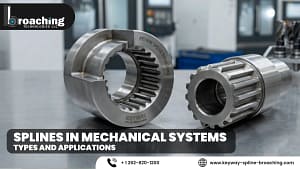
The advantage for blind work is control. Because the length and end point of the stroke are set on the machine, the slot can be made to stop at a precise point inside the bore. The tool never needs to pass through the part, so a closed end is no obstacle. For an internal spline — a series of grooves around the bore rather than a single slot — the same reciprocating cut is simply indexed around the circumference, one tooth space at a time.
Machine Rigidity and Tool Control in Blind Keyway Machining
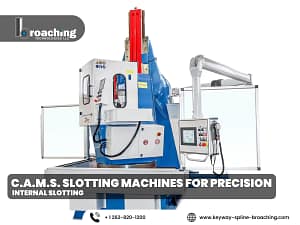
Rigidity is what makes this practical. The slotting tool reaches down into the bore on a relatively slender shank and is, in effect, cantilevered. Any deflection shows up as a slot that varies in width, tapers, or bells out at the entry, so the stiffer the machine and toolholding, the tighter the width and straightness that can be held. This is why blind and deep internal features are cut on rigid vertical slotting machines rather than on adapted equipment. Broaching Technologies runs this work on vertical C.A.M.S. slotting machines and is the North American source for C.A.M.S. slotting technology; the vertical architecture and rigidity are what allow controlled, repeatable cuts against a closed end.
End Relief: The Keyway Detail That Determines Fit
This is where blind keyways most often go wrong on paper, long before anyone cuts metal. A reciprocating single-point tool cannot leave a crisp, square corner where the keyway ends. The tool needs a short distance to finish its cut and reverse, and the last portion of travel can’t be brought to full depth cleanly — so the end of a blind keyway ramps or radiuses out instead of stopping in a vertical wall.
If the drawing assumes a square end and the mating key is cut to match, the key lands on that ramp and never seats to its full flank length. The part can measure “to depth” and still refuse to accept the key.
The fix is a relief: a small undercut groove machined at the end of the keyway, or a stated run-out allowance that gives the tool room to clear and gives the key a clean stopping point. In the drawing, call out where the keyway starts, where it must stop, and the relief — its length and depth, or a maximum run-out. Getting that on the print early is the difference between a feature that assembles the first time and one that comes back for rework.
Chip Clearance in Blind Keyway Machining
Because a blind feature has no bottom exit, chips collect inside the cut. Left there, they pack against the closed end, score the finished flanks, or wedge under the tool and cause chatter or breakage. None of those show up until the part is already scrapped.
Controlling chips means cutting in steps and retracting to clear them, directing coolant to flush the pocket, and keeping engagement light enough that chips break rather than string. It’s slower than an open cut, and that added cycle time is part of why blind features cost more than their through-hole equivalents. The difference is process time and setup — not a premium charged for its own sake.
Blind Keyway Tolerances: Width, Depth, and Position
A keyway is controlled by three dimensions: width, which sets how the key fits; depth; and the angular and positional location of the slot relative to the blind bore and any other feature. Width and location usually carry the tightest tolerances, because they govern how the key seats and how the assembly times up.
In North America, keyseat dimensions commonly follow ASME B17.1 (Keys and Keyseats); international drawings may reference DIN 6885 or ISO standards instead. Depth in a bore is often specified and checked over a pin or ball seated in the slot, rather than as a direct radial measurement, because that’s what can actually be gauged on the floor. The key can be dimensioned for a slip fit that assembles by hand or a tighter fit that locates precisely, depending on the class called out.
A blind feature adds one more variable to that list: the end condition — how cleanly, and how close to nominal, the slot terminates. What’s achievable on any given part depends on the material, the depth-to-diameter ratio of the bore, and the standard being held, so treat published tolerance tables as a starting point and confirm critical fits with the shop before release.
How Material and Heat Treatment Affect Blind Keyway Machining
The same geometry behaves very differently from one material to the next, and naming the material and its condition on the print matters more than it looks.
Carbon and alloy steels and cast iron generally slot predictably. Stainless steels and high-strength alloys such as Inconel and titanium work-harden — they get harder as they’re cut — and load the tool, so they need slower, controlled engagement, sharp tooling, and attention to heat to keep the cut from glazing over. Aluminum, bronze, and brass cut easily but can smear or build up on the tool edge, which affects the finish.
Condition matters too. A part that’s annealed, hardened, or cold-drawn will cut differently, and heat treatment can move a finished slot, so it’s worth deciding up front whether the keyway is cut before or after heat treatment. Broaching Technologies lists carbon and alloy steels, stainless steels, aluminum alloys, bronze and brass, and Inconel and other high-strength alloys among the materials it machines, with titanium and powdered metals noted for contract broaching work.
When Is a Blind Keyway the Right Choice?
A blind keyway is the right choice when the design genuinely requires it — the bore is closed, a through slot would break into a sealing surface or an adjacent bore, or the assembly needs the key to stop short of the opening.
It’s worth pressure-testing that requirement before committing to it. If the part could just as easily use a through bore, a through keyway is simpler, faster, and usually cheaper to produce. A blind feature carried over from an old print, or specified out of habit, adds cutting time, tool considerations, and inspection for no functional gain. When the closed end is a real requirement, slotting is the way to hit it accurately; when it isn’t, a through keyway is often the better engineering decision.
What to Include When Requesting a Blind Keyway Quote
A shop can quote and cut a blind keyway accurately when the drawing answers a few things up front. Having these ready avoids a round of back-and-forth:
- Bore diameter and depth, and whether the far end is closed or the slot simply stops short
- Keyway width, depth, and length — and how the depth is to be verified
- Where the keyway starts and where it must terminate
- The end relief or run-out allowance
- Material and its condition (annealed, hardened, cold-drawn)
- Tolerance and fit requirements for width and location
- Quantity — a single prototype or a production run
Blind internal keyways and splines are a specialty rather than a routine line item, and relatively few shops cut them accurately against a closed end. Broaching Technologies focuses on exactly this kind of work — blind-hole broaching and blind internal keyways and splines on vertical C.A.M.S. slotting machines, supported by in-house tooling and engineering — from Menomonee Falls, Wisconsin, serving manufacturers across North America, from single prototypes through production runs. If you have a closed-end part that needs an internal keyway or spline, sending the drawing or the part with the details above is the fastest way to get a clear read on how it should be cut and what it will take.
Frequently asked questions
Can a blind keyway be broached instead of slotted?
Conventional push or pull broaching needs a clear path through the bore for both the tool and the chips, so it isn’t suited to a truly blind feature. Blind internal keyways are cut mainly by vertical slotting, which lets the tool stop at a controlled interior point and withdraw. Some blind work uses specialized tooling and setups, but it’s a different process from standard through-broaching.
Why isn’t the bottom of my blind keyway square?
Because the single-point slotting tool has to finish its cut and reverse at the end of each stroke, it can’t leave a perfectly square interior corner — the end of the slot ramps or radiuses out. That’s normal, and it’s why a relief undercut or a stated run-out allowance belongs on the drawing so the mating key still seats correctly.
What’s the difference between a blind keyway and a blind spline?
A keyway is a single slot for one key; a spline is a series of grooves or teeth around the bore that engage a matching shaft. Both face the same blind constraint — the feature has to stop inside the bore — but a spline is produced by indexing the same controlled slotting action around the full circumference.
Do blind keyways cost more than through keyways?
Usually, yes. Slotting a closed feature takes more cycle time and setup than pulling a broach through an open bore, and chip clearance and end relief add steps. The cost comes from process time, not a surcharge — which is why a part that can use a through keyway is generally cheaper to produce.