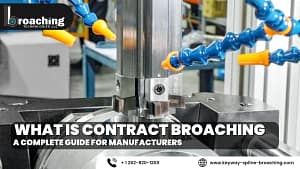
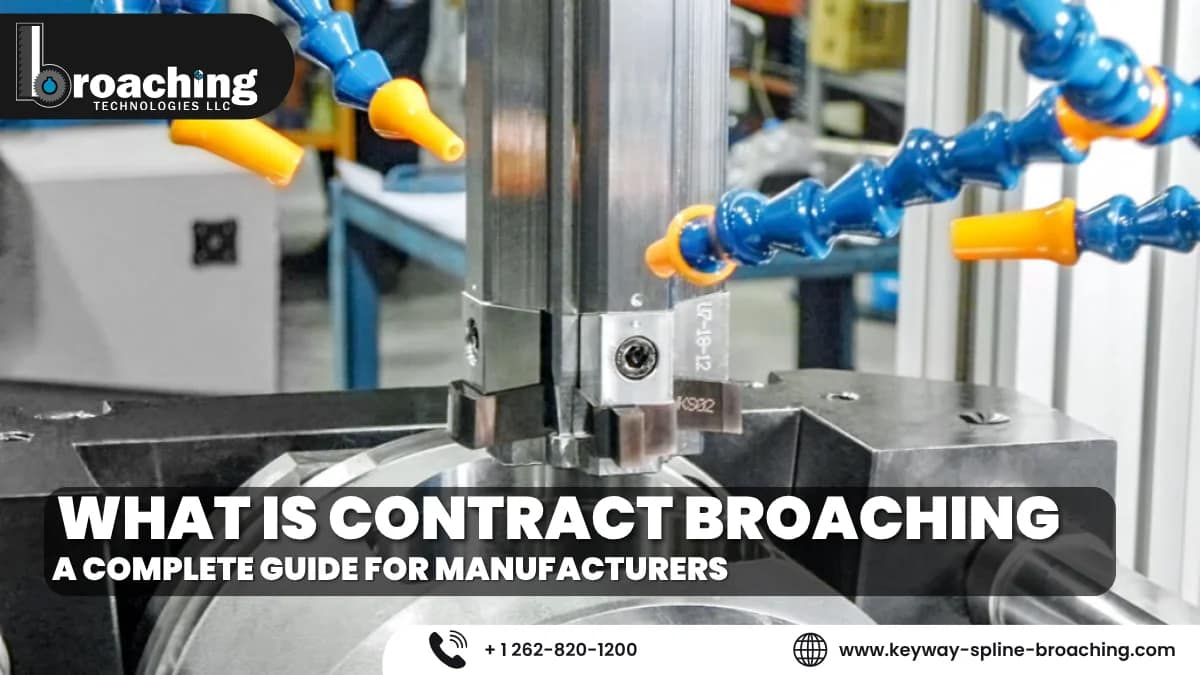
Contract broaching is a form of outsourced precision machining in which a manufacturer sends parts to a specialized broaching company to produce a specified feature. The manufacturer chooses to partner with a skilled provider instead of buying and managing broaching equipment. They rely on this partner to handle the process, following the part drawing and specifications.
Contract broaching can create features like internal keyways, splines, slots, and some blind-hole profiles. This depends on the available equipment and tooling. This approach helps manufacturers who need specialized broaching. It’s ideal when they don’t have the right equipment, tools, production capacity, or in-house expertise.
Key Takeaways
- Contract broaching means hiring a specialized manufacturer to handle broaching tasks. This approach is different from using in-house equipment and staff.
- Outsourcing lets manufacturers use specialized broaching machines, tools, and engineering know-how. They can also get process support. This way, they don’t need to set up a broaching operation on their own.
- Contract broaching works for keyways, internal splines, blind internal features, slots, and special profiles. This is possible when the supplier has the right equipment and tools.
- The economics depend on more than production volume. Tooling needs, part shape, material, tolerances, setup, inspection, and production quantities can all impact the total cost.
- Outsourcing is not automatically better than in-house broaching. The right choice depends on several factors: how often the process is needed, the required capability, production volume, available equipment, engineering resources, and the costs of keeping an internal operation.
- A contract broaching supplier should be evaluated on technical capability, tooling expertise, engineering support, inspection practices, equipment, production capacity, and communication rather than price alone.
Table of Contents
- What Is Contract Broaching?
- How Does Contract Broaching Work?
- What Makes Broaching Different From Other Machining Processes?
- What Types of Features Can Be Contract Broached?
- Why Do Manufacturers Outsource Broaching?
- Contract Broaching vs. In-House Broaching
- What Factors Affect Contract Broaching Cost?
- What Materials Can Be Contract Broached?
- When Does Contract Broaching Make Sense?
- When Might Broaching Not Be the Right Process?
- What Should You Look for in a Contract Broaching Supplier?
- What Information Should You Provide for a Broaching Quote?
- Commonly Asked Questions
- Need Contract Broaching for Your Parts?
What Is Contract Broaching?
Contract broaching means hiring a specialized manufacturing company for broaching tasks. This approach is often better than handling it in-house. The customer provides the part, drawing, specifications, quantities, and other needs. Then, the contract provider handles the machining process. They use their equipment, tools, engineering skills, and proper inspection methods.
Broaching itself is a machining process that uses a multi-tooth cutting tool called a broach. As the broach moves through the workpiece, its teeth remove material. This creates the needed profile. The process is commonly associated with keyways, splines, slots, and other internal or external forms.
The word “contract” describes how the manufacturing work is sourced rather than a separate type of broaching. A manufacturer can hire a specialized supplier for tasks like keyway broaching, spline broaching, blind-hole work, or slotting.
For a manufacturer, the workflow is simple:
- The customer shares part requirements.
- The supplier checks the geometry and process.
- Tooling and fixturing are set up.
- The broaching operation takes place.
- Finally, the finished feature is inspected to meet specifications.
The primary advantage of this arrangement is access to specialized capability. A manufacturer can skip buying equipment and training staff. Instead, they can use a ready-made broaching service when needed. This saves time and effort on maintenance and process management. Broaching Technologies, LLC offers contract broaching services. They also provide tooling and engineering for specialized uses. It offers service information on through-hole and blind-hole broaching. It also includes vertical and horizontal broaching equipment.
How Does Contract Broaching Work?
Contract broaching starts with an engineering review. Then, it moves through tooling, setup, machining, inspection, and delivery. Each project may vary, but this process is standard.
Part and Drawing Review
The process starts with the part requirements. A contract broaching supplier may need the part drawing, material specification, feature dimensions, tolerances, quantity, production schedule, and applicable inspection requirements. The drawing matters a lot. The feature geometry shows if a broaching operation works or if another method, like vertical slotting, is better.
A through-hole keyway and a blind internal spline both need internal machining. However, they require different tools and processes. The tool path, feature depth, workholding, chip management, and stopping requirements can differ substantially.
Process and Tooling Evaluation
After reviewing the drawing, the supplier evaluates how the feature can be produced. The evaluation can involve the part geometry, through-hole or blind-hole configuration, material and hardness, required tolerances, feature depth, part dimensions, production volume, available tooling, and workholding requirements.
Tooling is key. The broach needs to fit the right profile and work well under the given conditions. Fixturing and alignment also influence how consistently the tool engages the part. A skilled supplier should look beyond just whether a machine can fit the part. The supplier should think about whether the tooling and process can reliably create the needed feature.
Tooling and Machine Setup
After the process is set up, the supplier gets ready with the broach, fixture, workholding setup, and machine arrangement. Some jobs may be compatible with existing tooling. Others may require custom tooling or modifications. Tooling support can vary by application. It may include broach design, fixture design, sharpening, maintenance, or reconditioning. Tooling conditions are key for repeat production. It affects cutting performance and process consistency.
Broaching Operation
The broach removes material step by step during machining. This continues until the desired profile is created. In a conventional through-hole application, the broach can pass through the available opening. A blind internal feature poses a unique challenge. The tool needs to form the right shape without just cutting through the other side.
That changes the engineering requirements. Blind-hole broaching can require careful consideration of tool geometry, controlled cutting travel, chip relief, workholding, and feature depth. For manufacturers looking at blind keyways or splines, this difference matters. A process that works for a through feature may not work the same for a blind feature.
Inspection and Verification
After machining, the completed feature is evaluated against the applicable drawing and specifications. The inspection method depends on the geometry, tolerance, profile, and customer requirements. Verification may include different methods based on the application. These can be dimensional measurements, gauges, fixtures, profile inspections, or other suitable techniques. The objective is not simply to remove material. The broaching process needs to create the required feature. It must meet both dimensional and functional standards.
Delivery and Ongoing Production
After the parts have been processed and inspected, they can be delivered according to the agreed production requirements. For recurring work, the relationship can extend beyond individual production orders. Tool maintenance, sharpening, reconditioning, process tweaks, and continuous production support might be included in the ongoing manufacturing plan. That makes supplier capability important beyond the initial machining operation.
What Makes Broaching Different From Other Machining Processes?
Broaching is unique among machining processes. A single broach can have several cutting teeth. These teeth work together to create a specific profile. Broaching is less flexible than general-purpose CNC milling. However, it works well when the profile matches a dedicated broach, and the production costs are justified.
Milling can handle more shapes than broaching. It doesn’t need a special broach for each profile. The right process depends on several factors: the feature, tolerance, material, production quantity, accessibility, and cycle time needed. EDM can work well for tough shapes or materials. However, it functions differently than regular cutting and can have different costs.
Slotting and shaping work well for some internal forms. This is especially true when a tool needs controlled up-and-down movement instead of a regular through-broaching stroke. The key point is to choose broaching based on how it meets part and production needs. Don’t select it just because it can make the feature. Process selection depends on several factors: tooling investment, production volume, material, geometry, tolerance, and machine availability.
What Types of Features Can Be Contract Broached?
The features in contract broaching depend on the supplier’s machines, tools, and engineering skills.
Common applications are:
- Internal keyways
- Internal splines
- Blind keyways
- Blind splines
- Slots
- Other specialized internal profiles
Keyways
A keyway is a machined slot that accommodates a key used to connect components and transmit torque. Internal keyways are commonly associated with components such as gears, hubs, pulleys, sprockets, and couplings.
The required keyway dimensions and fit depend on the part design and the mating components. The final shape should come from the drawing and engineering specs, not just a generic keyway description.
Internal Splines
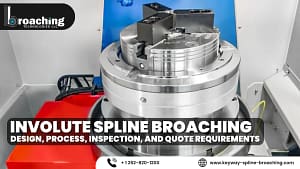
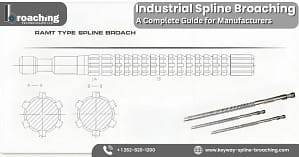
Internal splines have several teeth or ridges. These engage with an external spline. They are often used to transmit rotational torque and control engagement between parts. Different spline profiles can require different tooling. Contract broaching can create profiles such as involute, straight-sided, or serrated splines. This depends on what the supplier can do.
Blind Keyways and Splines
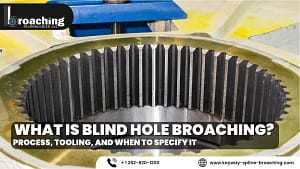
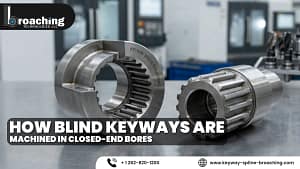
A blind keyway or spline terminates within the part rather than passing completely through it. This adds more manufacturing factors. The cutting tool needs to create the right shape and stop at the correct depth. Tool geometry, cutting travel, chip relief, workholding, and machine rigidity are important. Blind internal broaching should be seen as its own application. It shouldn’t just be viewed as a type of through-hole broaching.
Slots and Specialized Internal Forms
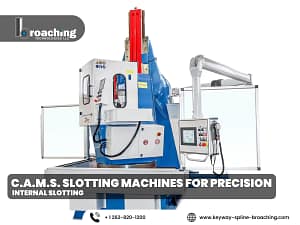
Contract broaching can include internal slots and special profiles. This depends on whether the supplier has the right equipment and tooling. Vertical slotting works well when you need controlled vertical tool movement. It’s especially useful when traditional through-broaching setups aren’t a good fit. Evaluate equipment capabilities based on the actual part geometry, not just on the term “broaching.”
Why Do Manufacturers Outsource Broaching?
Manufacturers often think about outsourcing for several reasons. They may need specialized skills, more production capacity, engineering help, or want to avoid spending on dedicated equipment.
Avoiding Dedicated Equipment Investment
A manufacturer that only sometimes needs broaching might not have enough demand to buy a dedicated broaching machine. An internal operation also involves more than the initial machine purchase. The manufacturer may need floor space, maintenance resources, operators, tooling, fixtures, process development, inspection capability, and ongoing equipment utilization. Contract broaching lets a manufacturer tap into an existing operation. This means they don’t have to build all parts of the infrastructure themselves.
Accessing Specialized Tooling Knowledge
Broaching tooling is application-specific. The right tooling approach depends on several factors: the profile, material, geometry, depth, and production needs. A manufacturer that seldom uses broaching might lack the skills to develop and manage that tooling effectively. Working with a specialist gives you quick access to engineering and tooling knowledge. Building this expertise internally would take a lot of time and money.
Handling Specialized or Difficult Features
A manufacturer might excel in CNC turning and milling. However, they may not have the right equipment or know-how for a specific blind spline, internal keyway, or specialized form. Outsourcing lets a supplier with the right tools handle the specialized operation.
Adding Production Capacity
Outsourcing can also supplement existing manufacturing resources. If an internal broaching machine creates a production bottleneck, you can transfer some work to a contract supplier. This adds capacity without needing immediate capital investment.
Supporting Prototype and Production Work
Contract broaching is not necessarily limited to large production runs. Outsourcing works best when the supplier has the right skills. It also depends on tooling needs, part shape, and project costs. Evaluate prototype, short-run, and recurring production applications if the broaching process is available.
Contract Broaching vs. In-House Broaching
Neither approach is automatically better. The right choice depends on production requirements, equipment utilization, technical capability, tooling needs, and the resources available to the manufacturer.
| Consideration | Contract Broaching | In-House Broaching |
| Equipment investment | Supplier provides the equipment | Manufacturer purchases and owns equipment |
| Specialized expertise | Accessed through the supplier | Developed internally |
| Tooling management | Can be handled by supplier | Customer manages tooling |
| Maintenance | Supplier responsibility | Customer responsibility |
| Internal capacity | Reduces demand on internal resources | Uses internal resources |
| Process control | Shared with an external partner | Direct internal control |
| Flexibility | Useful when demand varies | Useful when demand is predictable |
| Capital utilization | No dedicated machine required by customer | Equipment needs sufficient utilization |
| Supplier dependency | Higher | Lower |
| Best fit | Specialized, variable, or outsourced requirements | Consistent demand with justified equipment investment |
The key question is not simply which option has the lower quoted machining price. A manufacturer should consider how often the process will be required, what equipment and tooling it would need, how much production volume is available to utilize that equipment, and what engineering and maintenance resources would be required.
For a company with consistent, substantial broaching demand, an internal investment may deserve evaluation. For a manufacturer with occasional, specialized, or variable requirements, outsourcing may provide access to the capability without the same level of capital commitment.
What Factors Affect Contract Broaching Cost?
Contract broaching costs vary from project to project. Pricing depends on several factors, including tooling, part geometry, material, tolerances, production volume, setup requirements, and the complexity of the required feature.
Part Quantity
Production quantity affects the economics of tooling and setup. A one-time prototype and a recurring production program can have very different cost structures. With larger production quantities, fixed setup and tooling costs can be distributed across more parts. With low-volume work, those costs may represent a larger portion of the effective per-part cost.
Tooling Requirements
Existing tooling may simplify a project, while a custom broach or fixture can add engineering and tooling expenses. For that reason, the relevant question is not only what it costs to machine an individual part. It is also what tooling and preparation are required to produce the feature accurately and repeatedly.
Part Geometry
A straightforward through keyway may require a different setup than a deep internal spline or blind profile. Geometry can influence machine selection, tooling, workholding, cutting conditions, inspection, and setup requirements. More complex geometry may therefore require additional engineering before production begins.
Material
Material properties can influence cutting behavior and tooling requirements. Broaching Technologies identifies carbon and alloy steels, stainless steel, aluminum, brass, titanium, Inconel, and powdered metals among the material categories associated with its contract broaching capabilities. The actual suitability of a material should still be evaluated based on the specific grade, hardness, geometry, and required result. Providing only “steel” as the material description may not give a supplier enough information for a precise engineering evaluation.
Tolerances and Inspection
Tighter tolerances can require more careful process control and verification. A quote should therefore be based on the actual drawing and specifications rather than a general description such as “precision keyway.” The supplier needs to understand the required dimensions, profile characteristics, fit requirements, and inspection standards.
Setup and Fixturing
How a part is positioned and supported can affect both setup time and repeatability. This is especially important for parts with unusual shapes, blind features, special orientation requirements, or limited access for the broaching tool.
What Materials Can Be Contract Broached?
Broaching can be performed on a range of metals and alloys, but material suitability is application-specific. Broaching Technologies identifies carbon and alloy steels, stainless steel, aluminum, brass, titanium, Inconel, and powdered metals among the material categories it works with. Material selection matters because hardness, toughness, machinability, work-hardening behavior, and other material characteristics can influence tool selection and process conditions.
Manufacturers requesting a contract broaching quote should provide the specific material grade and condition whenever possible. Two materials that are both broadly described as “steel” can have different machining and tooling requirements.
When Does Contract Broaching Make Sense?
Contract broaching can make sense when a manufacturer does not own broaching equipment, requires a specialized feature, has limited internal capacity, or does not want to develop dedicated tooling and process expertise. It can be particularly useful when broaching is an occasional requirement. In that situation, purchasing and maintaining dedicated equipment may be difficult to justify if the machine would remain underutilized for much of the year.
Outsourcing can also make sense when the required feature is specialized. A manufacturer may have extensive CNC capabilities but still need an external supplier for a blind spline, custom internal form, or other feature requiring specialized broaching equipment or tooling. Production capacity is another consideration. If internal equipment is already committed, outsourcing a specific operation can help prevent that operation from becoming a bottleneck.
Engineering support can also influence the decision. Manufacturers that do not regularly develop broaching tooling may benefit from working with a supplier that can evaluate the drawing, tooling requirements, fixturing, and process before production. The opposite situation may favor in-house production. If broaching is needed frequently and production volumes are high, it may be worth evaluating dedicated equipment. This is especially true when equipment utilization is strong and the manufacturer has the necessary engineering and maintenance resources.
When Might Broaching Not Be the Right Process?
Broaching works well for certain profiles, but it is not always the best machining method for every part. Low-volume work, unique shapes, limited tool access, or specialized machining requirements can make milling, EDM, slotting, shaping, or other methods a better choice. Tooling economics can also influence the decision. If a part requires specialized tooling but only a very small number of components will ever be produced, the tooling investment should be compared with the cost and flexibility of alternative machining methods.
Choose the right process based on the overall manufacturing situation. Consider factors such as part geometry, material, tolerance, feature depth, production quantity, tooling requirements, available equipment, and total production cost.
What Should You Look for in a Contract Broaching Supplier?
Price is only one part of supplier selection. A manufacturer should first determine whether the supplier can produce the required feature. Then, it should evaluate the engineering, tooling, quality, equipment, and production support available.
Technical Capability
The supplier should be able to discuss the specific keyway, spline, blind feature, slot, or internal form shown on the drawing. When evaluating a supplier, consider part size, material, tolerance, feature depth, profile, and expected production volume.
Tooling Capability
Tooling support can be especially important for specialized or recurring work. Ask whether the supplier can support broach design, fixture development, sharpening, maintenance, or reconditioning when those services are relevant to the project.
Engineering Support
A capable supplier should be able to discuss manufacturability before machining begins. This can help identify potential issues with geometry, tooling access, workholding, tolerances, or production assumptions. Addressing these issues early can prevent larger production problems later.
Quality and Inspection
Ask how the finished feature will be verified against the drawing and specifications. The appropriate inspection method depends on the part and its tolerance requirements. The supplier should be able to explain how inspection requirements are incorporated into the production process.
Equipment and Process Range
Machine capability can determine whether a supplier can handle a particular application. Broaching Technologies states that it operates both vertical and horizontal broaching systems and supports blind-hole applications through vertical slotting technology.
Production Flexibility
The supplier should also be able to accommodate the expected quantity and production schedule. Technical capability alone is not enough if the supplier cannot support the required volume or delivery timeline.
What Information Should You Provide for a Broaching Quote?
A clear RFQ provides the supplier with the information needed to evaluate the application without making assumptions. The best starting point is the part drawing and revision. Include the required quantity and important part dimensions. The material specification should identify the exact material grade and, when relevant, its hardness or heat-treatment condition.
Feature information should identify the keyway or spline specification, bore size, feature depth, profile requirements, orientation, and applicable dimensional tolerances. Inspection and surface-finish requirements should also be provided when they are part of the engineering specification.
Production information is equally important. The supplier should know whether the job is a prototype, short run, or recurring production program, along with the expected order quantity, estimated annual volume when available, and required delivery schedule. Providing the complete drawing helps the supplier evaluate the geometry, tolerances, feature relationships, and manufacturing requirements together. For a custom contract evaluation, Broaching Technologies requests part drawings or specifications so its team can review the application before preparing a quote.
Frequently Asked Questions
Is contract broaching the same as contract machining?
Not exactly. Contract machining is a general term for outsourced manufacturing. Contract broaching specifically involves outsourcing broaching operations to a specialized provider. These operations may include keyways, splines, slots, or blind internal features, depending on the supplier’s equipment and tooling capabilities.
Is contract broaching only for high-volume production?
No. Contract broaching can be considered for prototype, short-run, and production applications when the supplier has the appropriate equipment and tooling. Whether outsourcing makes economic sense depends on the part, tooling requirements, quantity, tolerances, and overall production needs.
Can contract broaching produce blind keyways?
Yes, specialized providers can produce blind keyways when the equipment, tooling, geometry, and process are appropriate. Blind features require additional attention because the tool must create the required profile to a controlled depth rather than pass completely through the workpiece. Broaching Technologies specifically describes blind keyway and blind spline capabilities using vertical slotting equipment.
Does contract broaching require custom tooling?
Not necessarily. Some applications can use existing tooling, while others require specialized or modified broaches and fixtures. The drawing, profile, material, dimensions, production quantity, and available tooling determine what is required.
Is broaching always cheaper than CNC machining?
No. Broaching can be highly efficient for repeatable profiles, but costs vary. Tooling, geometry, quantity, material, setup, tolerances, inspection, and other production requirements all affect the overall cost. There is no universal rule that broaching will be less expensive for every part.
Should I outsource broaching or bring it in-house?
Start by looking at production frequency and volume. Then consider equipment investment, tooling, engineering expertise, maintenance, available floor space, process control, and supplier requirements.
Outsourcing may be the better option for occasional or specialized broaching. If there is a steady, high-volume need, however, it may be worth evaluating an in-house operation.
What should I send when requesting a contract broaching quote?
Provide the part drawing and revision, material specification, quantity, required feature, tolerances, inspection requirements, and desired production timing. Additional information about annual volume, tooling, heat treatment, and special requirements can help the supplier evaluate the application more accurately.
Need Contract Broaching for Your Parts?
For keyways, splines, blind internal features, slots, or specialized broached profiles, start with an engineering review rather than comparing price alone. Broaching Technologies, LLC offers contract broaching, tooling, and engineering support. Its current service information identifies capabilities for keyways, splines, blind-hole applications, specialized tooling, and both vertical and horizontal broaching systems.
Manufacturers can provide part drawings or specifications for contract evaluation. Sharing complete technical information allows the supplier to review the application, determine the appropriate manufacturing approach, and prepare a more accurate quote. If you have a part that requires contract broaching, provide the drawing and specifications for an engineering review and quote.