Open up almost any gearbox, transmission, or drive shaft assembly and you will find splines somewhere inside. Not bolts. Not welds. Splines, a series of ridges and grooves cut along a shaft or inside a bore that lock two parts together so they rotate as one.
Cutting those splines accurately, consistently, and at production volume is what industrial spline broaching does. It is one of those processes most people outside manufacturing have never heard of, yet it sits behind the reliability of everything from car transmissions to aircraft actuators to industrial pumps.
This guide breaks down how the process works, why it matters so much for precision components, and what manufacturers should know when sourcing this kind of work.
What Industrial Spline Broaching Actually Involves
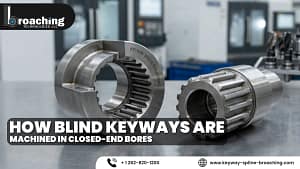
Splines look complicated, but the idea behind them is simple. Instead of one keyway holding two parts together, splines use many small teeth spread around the shaft or bore. That spreads the load evenly, which means the connection can handle far more torque than a single key ever could.
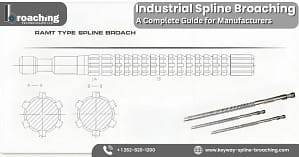
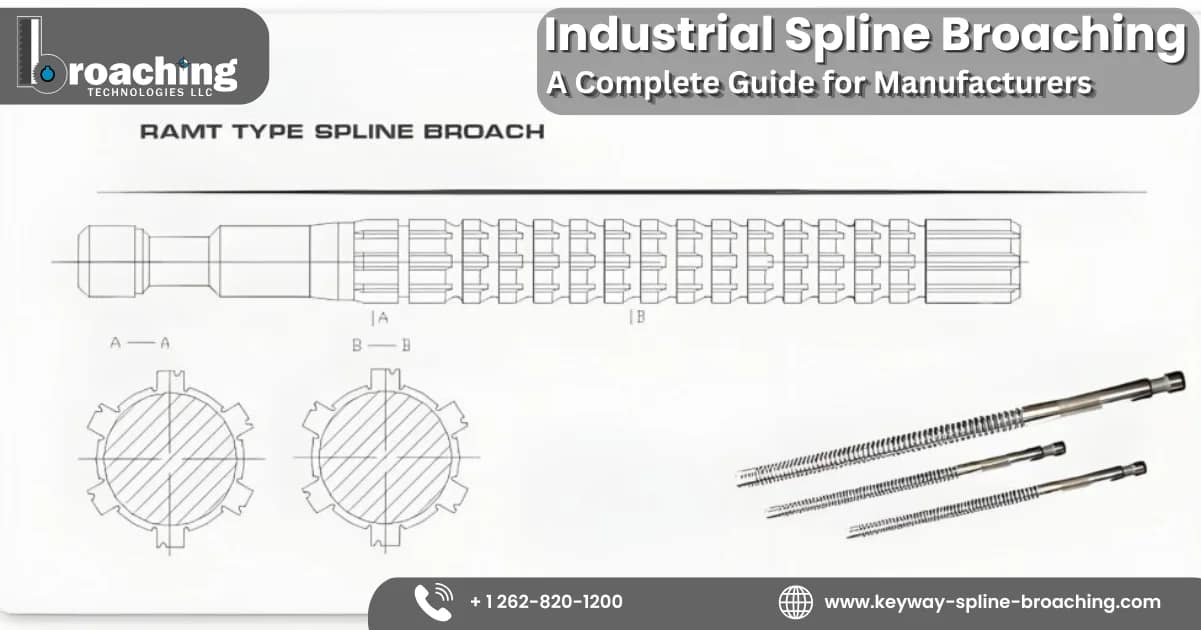
Industrial spline broaching is the machining process used to cut those teeth, usually inside a bore, though external splines on shafts are also broached in some cases. A broaching tool, shaped with the exact spline profile needed, is pushed or pulled through the workpiece in a single pass. Each tooth on the broach cuts a little deeper than the last, until the final pass leaves the finished spline profile behind.
Keyway Spline Broaching specializes in exactly this kind of precision work, producing splined components that meet tight tolerances for industries where accuracy genuinely matters.
The result of a good broaching pass is a clean, accurate spline profile, repeated identically across every part in a production run. That consistency is the whole point.
Why Splines Are Used Instead of Simple Keyways
A keyway is a single slot with a single key. It works fine for moderate loads. But once torque demands go up, or once a connection needs to handle reversing loads, vibration, or repeated assembly and disassembly, a single keyway starts to struggle.
Splines solve this in a few ways:
- Load is spread across many teeth, not concentrated on one small area
- Higher torque capacity without increasing shaft diameter
- Better fatigue resistance because stress is distributed evenly
- Precise alignment between mating parts, which matters for things like steering shafts and gear couplings
- Easier disassembly for parts that need regular maintenance, like power take-off shafts
This is why industrial spline broaching is so common in automotive drivetrains, aerospace actuators, and heavy machinery, anywhere torque transmission needs to be both strong and reliable over millions of cycles.
Common Spline Profiles Used in Industry
Not all splines look the same. The profile shape affects strength, manufacturing cost, and how the mating parts fit together. Here is a quick overview of the most common types:
| Spline Type | Profile Shape | Typical Use |
| Involute Spline | Curved tooth profile, similar to gear teeth | Automotive, aerospace, high-torque drives |
| Straight-Sided Spline | Flat-sided rectangular teeth | Older designs, agricultural equipment |
| Serrated Spline | Fine, shallow teeth | Steering components, fine adjustment fittings |
| Helical Spline | Angling tooth profile | Applications needing axial load transfer |
Involute splines are by far the most widely used today. Their curved profile distributes stress better than straight-sided teeth, and the same broaching principles used for gear cutting apply, which keeps production costs reasonable even at high precision levels.
How the Broaching Process Actually Works
It helps to walk through the actual steps, because each one affects the quality of the finished part.
Step one: Tool design. The broach itself is custom-made to match the exact spline profile required. This tool is the single most important factor in the entire process. Get the broach geometry wrong, and every part cut with it will be wrong too.
Step two: Workpiece preparation. The bore or shaft is pre-machined close to final size, leaving just enough material for the broach to remove cleanly.
Step three: The broaching pass. The broach is pushed or pulled through the workpiece, usually under hydraulic pressure. Each successive tooth on the broach removes a thin layer of material, gradually forming the full spline profile.
Step four: Inspection. Finished parts are checked against the required tolerances, tooth profile, pitch, depth, and overall fit with the mating component.
Because the entire spline is formed in a single pass, broaching is one of the fastest ways to produce splined components at scale, while still holding tight tolerances part after part.
Tolerances and Quality Standards
Tolerances matter enormously in spline work. A spline that is slightly out of profile might still fit together with its mating part, but under load, that small error concentrates stress in the wrong places, and the part fails far sooner than it should.
Most industrial spline work follows established standards, including ANSI B92.1 for involute splines and various ISO standards depending on the application and region. These standards define tooth profile, fit classes, and acceptable tolerance ranges based on the spline’s intended use.
For applications like steering systems, aerospace actuators, or anything safety-critical, tolerance control is not optional. Industrial spline broaching done to a proper standard ensures that every part in a batch performs identically, which matters just as much for a part made today as one made five years from now on a repeat order.
Materials Commonly Used for Splined Components
The material a splined part is made from affects how the broaching process is set up, and how the finished part performs in service.
Carbon Steel (AISI 1045 and similar): The most common choice for general industrial splines. Good machinability, reasonable strength, and widely available.
Alloy Steel: Used where higher strength and fatigue resistance are needed, common in automotive and heavy equipment drivetrains.
Stainless Steel: Selected for corrosion resistance, often in food processing or marine equipment.
Hardened Steel: For some high-wear applications, splines are cut before hardening, then the part is heat treated afterward. In other cases, broaching hardened material directly is required, which calls for different tooling and cutting strategies.
Choosing the right material, and understanding how it will be heat treated, if at all, needs to happen before broaching tooling is designed, not after.
Industries That Depend on Spline Broaching
Industrial spline broaching shows up across a wide range of sectors, often in components that are easy to overlook but critical to how a machine performs.
- Automotive: Transmission input and output shafts, differential components, steering shafts
- Aerospace: Actuator drive components, landing gear mechanisms
- Agriculture: Power take-off shafts on tractors and implements
- Industrial Machinery: Gearbox couplings, pump drive shafts, conveyor drive components
- Oil and Gas: Drill string components, downhole tool connections
In every one of these applications, the spline connection is doing real work, transferring torque reliably, cycle after cycle, often in conditions that are dirty, hot, or under heavy vibration.
What to Look for in a Broaching Partner
Not every machine shop can handle precision spline work well. A few things separate a reliable partner from one that will cause problems down the line.
Tooling capability. Custom broach design and manufacturing in-house means faster turnaround and better control over tolerances, rather than relying on third-party tooling suppliers with their own lead times.
Tolerance verification. Proper inspection equipment, gear and spline checking gauges, not just general-purpose measuring tools, is essential for confirming parts actually meet the required standard.
Experience with your material. Broaching hardened steel is very different from broaching mild steel. A shop experienced across multiple material types is far less likely to run into unexpected tool wear or finish issues.
Volume flexibility. Whether you need a handful of prototype parts or tens of thousands for a production run, the right partner should be able to scale without sacrificing consistency.
Keyway Spline Broaching covers exactly these bases, combining tooling expertise with the inspection processes needed to keep production runs consistent from the first part to the last.
Frequently Asked Questions
Q: What is the difference between broaching and milling for splines?
A: Broaching cuts the full spline profile in a single pass and is much faster for production volumes. Milling is more flexible for prototypes or low-volume work but takes longer per part.
Q: Can splines be broached into hardened materials?
A: It depends on the hardness level. Some hardened materials can be broached with the right tooling, while others require cutting the spline before heat treatment.
Q: How accurate can broached splines be?
A: Very accurate. Broaching can hold tight tolerances consistently across large production runs, which is one of the main reasons it remains the standard method for splined bores.
Q: What standards govern spline tolerances?
A: ANSI B92.1 is widely used for involute splines in the US, alongside various ISO standards depending on the industry and region.
Q: How long does a typical broaching tool last?
A: Tool life depends on the material being cut and the spline profile, but a well-maintained broach can produce thousands of parts before requiring resharpening.
Conclusion
Splines do not look like much on a drawing, just a ring of small teeth around a hole or a shaft. But the role they play in keeping machinery running reliably is enormous, and getting them right depends entirely on how they are made.
Industrial spline broaching remains the standard process for producing splined components at the accuracy and volume that modern manufacturing demands. From tooling design through to final inspection, every step in the process affects whether the finished part performs the way it is meant to, for the first cycle and the millionth one.
For manufacturers who need splined components that hold up under real-world conditions, working with a partner who understands industrial spline broaching from start to finish makes all the difference.