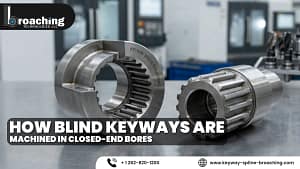
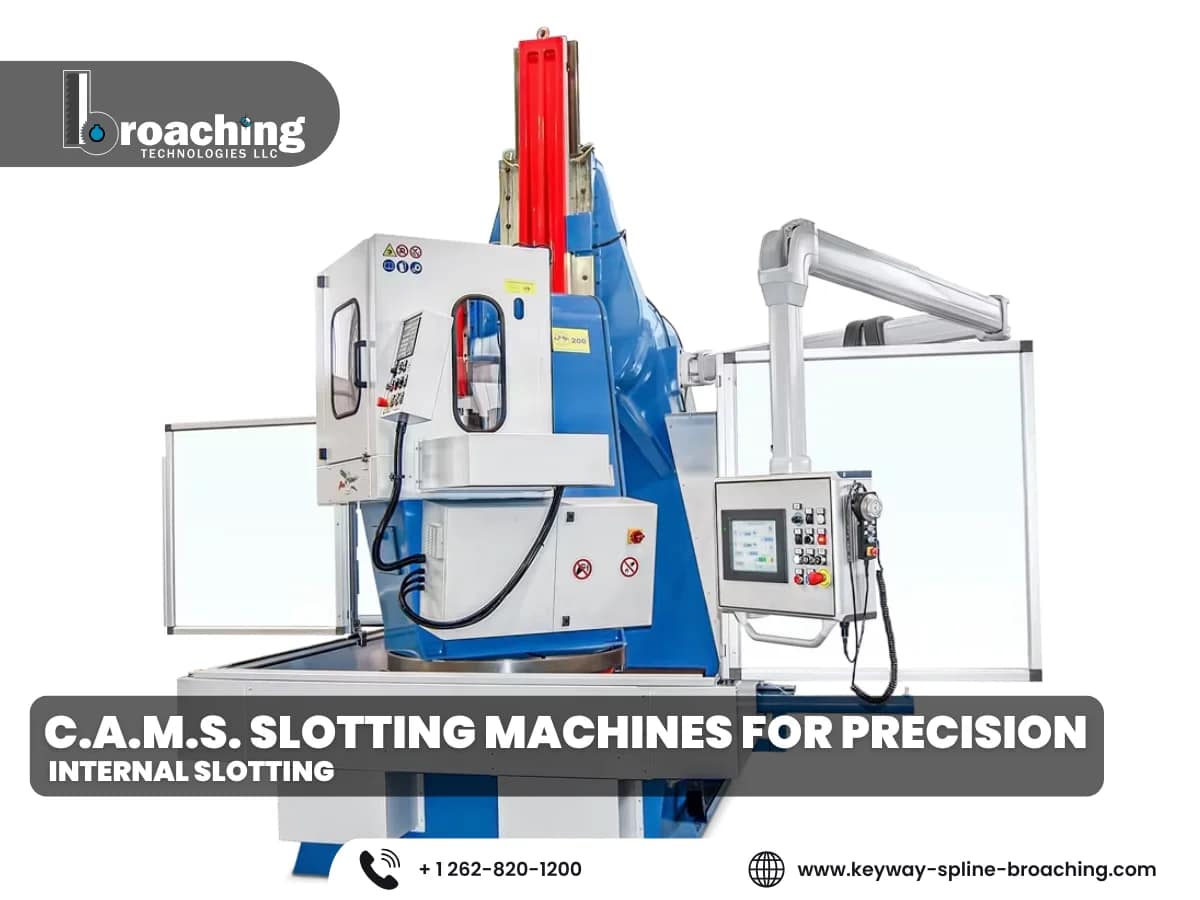
A hub arrives at the bench with a blind internal keyway and a run of forty pieces. A milling cutter can’t reach the interior of the bore without leaving residue. Grinding a dedicated broach for forty parts won’t pay for itself. This small daily bottleneck causes many shops to lose profit. A C.A.M.S. vertical slotting machine can solve this problem with high efficiency.
C.A.M.S. has made precision slotting machines in Italy since 1975. Broaching Technologies, LLC is the exclusive North American distributor for this line. They operate from Menomonee Falls, Wisconsin. Our guide skips the brochure language. It shows what these machines cut, where they save time, and where they do not. It also explains how a shop chooses between slotting and broaching. If you machine internal features, you will leave knowing exactly where a C.A.M.S. slotting machines fit your work.
What Is a C.A.M.S. Slotting Machine?
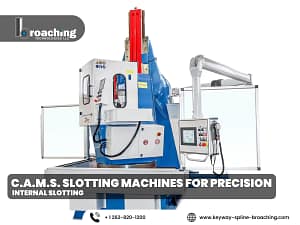
C.A.M.S. machine is a vertical slotting machine. It’s a metal-cutting tool. It shapes internal keyways, splines, grooves, and blind slots. A single-point tool moves straight down through the part to do this. Since 1975, it has built this line in Italy. It boosts efficiency with NC-controlled indexing. It also has a programmable stroke and feed, plus an electronic tool lift.
Here’s the motion in plain terms. The tool rides a ram that drives straight down, shaves a thin layer off the bore, then lifts back up empty. Between strokes, the table advances or rotates the part a set amount. The shape appears pass by pass. It’s a proven process; what C.A.M.S. adds fine control over every part of that cycle.
Slotting is part of a larger group of tasks that many shops are familiar with. This includes keyway cutting, spline production, and contract broaching. Where a rotary tool can’t reach and a broach isn’t worth building, the slotter is usually the right answer.
How C.A.M.S. Machines Solve Difficult Internal Machining Problems
To speed up slotting, you have to know where the minutes actually go. There are four places, and C.A.M.S. features target each one.
Cutting Setup and Hand-Repositioning
On a manual slotter, you need to stop and hand-turn the part for each spline cut. That’s slow, and spacing drifts. C.A.M.S. machines index automatically with NC control. They use one to four axes and an electronic rotary table. This setup allows the part to rotate as programmed. Every tooth lands where it should, without an operator babysitting the dividing head.
Shrinking the Dead Return Stroke
Roughly half of every stroke cuts nothing; the tool is just traveling back up. Two features attack that waste. The electronic tool lift pulls the tool back, so it doesn’t drag and get dull. The programmable stroke length stops the ram from moving beyond what’s needed. Live tool edge, shorter travel, smaller total cycle.
Cutting rework and scrap
Late rejects are the most expensive minutes in the building. Electronic feed repeats the same rate on every part instead of relying on operator feel. Tolerance stays consistent during the run, so fewer parts go in the scrap bin. This is crucial for high-value parts, especially when the slot is the final operation.
Raising Machine Use
A single programmable slotter can run various keyways and internal shapes, like splines. That’s a better way to use one footprint instead of moving parts between setups. In a busy shop, higher use on one machine often beats buying another.
Add it up, and the story isn’t “this machine is faster.” It’s “this machine wastes less” — less handling, less dead motion, less scrap, less idle iron.
Choosing The Right C.A.M.S. Model
You don’t need a full spec sheet to place the lineup. Think in three tiers. Smaller frames (around the 200–300 class) are perfect for compact parts. They work well for custom one-offs and shops starting with programmable slotting. The mid-range (350–500 group) holds most production. This includes deeper cuts, tougher materials, and rotary indexing for multi-slot work. The “E” variants add automation and extra axes. At the top, the 850 is the heavy hitter, built for oilfield, aerospace, and other large, demanding parts.
| Tier | Models | Best fit |
| Entry | 200, 250, 300 | Small or custom parts; first programmable slotter |
| Production | 350, 400 / 400E, 500 / 500E | Multi-slot runs, harder materials, added automation |
| Heavy | 850 | Large oilfield, aerospace, and demanding sectors |
Slotting vs. Broaching: Which Process Fits?
Both cut internal shapes, so shops rightly ask which to use. The rule fits on a sticky note: broach when the profile is fixed and volume is high; slot when it isn’t.
Broaching pushes a multi-tooth tool through in one fast stroke, but each profile needs its own broach real cost and lead time. Slotting builds the shape over several passes with a cheap standard tool: slower per part, far more flexible.
| Factor | C.A.M.S. slotting | Broaching |
| Best volume | Low to medium; prototypes, repairs | Medium to high production |
| Tooling cost | Low; standard single-point tools | Higher; dedicated broach per profile |
| Changeover | Quick, programmable | Slower; physical tool changes |
| Cycle speed | Slower (pass by pass) | Very fast (single stroke) |
| Blind / enclosed slots | Strong; reaches inside blind features | Limited for some blind work |
| Flexibility | High; one machine, many profiles | Lower; profile fixed by the broach |
Plenty of shops keep both, which is why Broaching Technologies sells the machines and offers contract broaching alongside them.
Common Mistakes That Cost Efficiency
The machine rarely fails you; the spec does. The most common mistake is buying too little rigidity or stroke for the parts you actually cut, then fighting chatter and poor finish forever. The second is skipping indexing on a shop that does spline and gear work — without NC axes and a rotary table, you’re back to slow hand-turning and inconsistent spacing. The third is running a tired single-point tool. On a slotter the tool does all the work, so a dull edge drags down finish and speed at the same time. None of these are exotic. They’re just easy to overlook when a machine looks capable on paper.
How Experienced Shops Set Up for Efficiency
Getting the most from a slotter starts before the first chip. A rigid, square fixture is non-negotiable — a loose part turns every advantage into chatter. From there, seasoned operators follow a simple rhythm:
- Program stroke length to the feature, not the full travel, to trim dead cycle time.
- Turn on electronic tool lift for any job that allows it, to protect the edge.
- Match tool geometry to the material, and keep it sharp; the single point does all the cutting.
- Set rotary indexing once for repeat spline or gear work and save the program, so the next batch spaces itself.
These habits are where a capable machine turns into an efficient one.
Where C.A.M.S. Slotting Machines Are Used
C.A.M.S. slotters run wherever internal shapes meet variety. Common work includes blind and through keyways in hubs and couplings, involute and straight-sided splines for drivetrains, and internal squares, hexes, and double-Ds cut to spec. Heavier oilfield and aerospace parts land on the larger frames. Just as often, these machines handle the unglamorous but profitable jobs of prototypes, small batches, and repairs — where a dedicated broach would never earn its keep.
What Affects the Cost of a Slotting Machine
Machine price depends on frame size, stroke capacity, number of NC axes, and automation level; a compact single-axis unit and a four-axis production machine sit far apart. The smarter number to watch, though, is cost per part.
Slotting keeps tooling cost low and changeovers quick, so it usually wins on total cost for low-to-medium runs and mixed work. Broaching wins on cost per part once volume is high and the profile is locked. Factor in tool life, scrap rate, and operator time, not just the sticker when you compare options.
Working With Broaching Technologies
C.A.M.S. slotting machines improve efficiency by attacking waste, not by chasing horsepower. Automatic indexing, programmable strokes, tool lift, and repeatable feed turn a slow old process into a controlled one while keeping setup cheap enough that short runs and repairs still make money.
The smart move is matching the process to the job: slot for flexibility and blind internal work, broach for speed at volume. Get that call right and you scrap less, wait less, and quote tighter.
Manufacturers weighing a C.A.M.S. machine or slotting against contract broaching can work directly with Broaching Technologies, LLC in Menomonee Falls, Wisconsin, the exclusive North American dealer, to size the right model and process the parts they actually run.
Frequently Asked Questions
How do C.A.M.S. slotting machines actually cut cycle time?
They remove wasted motion rather than just cutting faster. NC indexing kills hand-repositioning between passes, programmable strokes trim dead travel, tool lift keeps the edge sharp, and repeatable feed cuts scrap. The savings come from waste you stop paying for.
Should I choose slotting or broaching for internal splines?
For a high volume of one fixed spline, a broach wins on speed and cost per part. For lower volumes, changing profiles, or blind slots, slotting is more flexible and far cheaper to set up. Many shops run both.
Which C.A.M.S. Is the model right for my parts?
Match the frame to part size, material, feature type, and how many axes the job needs. Compact models suit small or custom parts; mid-range handles multi-slot production; the 850 covers large, heavy-sector work. Broaching Technologies helps size the model to your actual mix.
Can a C.A.M.S. machine fit into my existing CNC workflow?
Usually, yes. NC and CNC-capable models talk to standard automation, and Broaching Technologies handles integration, setup, and NC-programming so it drops into your line.
What support comes with the machine?
As the exclusive North American dealer, Broaching Technologies provides installation, calibration, hands-on operator training, tool re-sharpening, and fast access to replacement parts and tooling from Italian and domestic suppliers.
Can you help decide if my part is a good fit before I buy?
Yes. Their team reviews part designs, recommends slot or spline profiles, and adjusts tolerances for machinability useful before committing to a machine or a process.