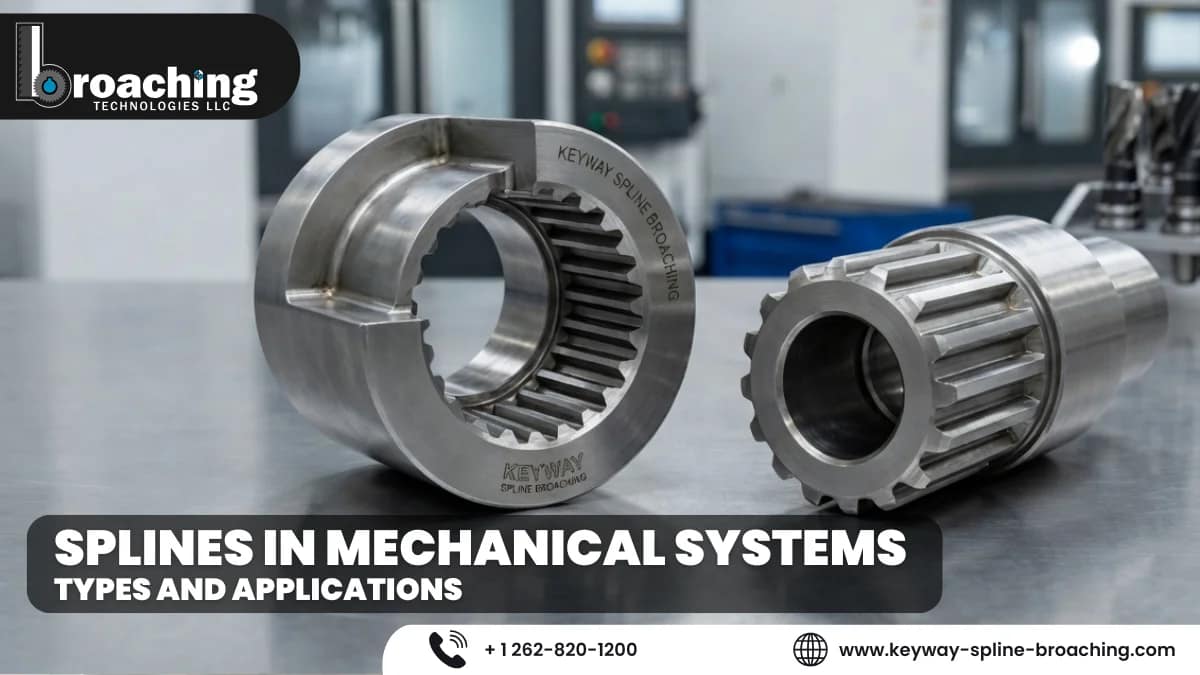
Power has to go somewhere. In any machine that moves – a car, a turbine, a drill press, an industrial robot – torque has to transfer from one component to another without slipping, without wobbling, and without failing under load. That’s exactly the job that splines in mechanical systems do.
They connect shafts to hubs, gears to drives, and components to components with precision and strength that no other joining method matches. This guide covers what splines are, the main types, how they’re made, and where they get used across real engineering applications.
What Are Splines in Mechanical Systems
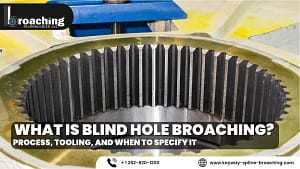
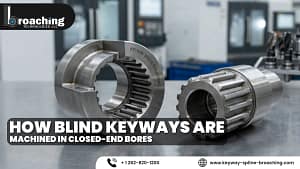
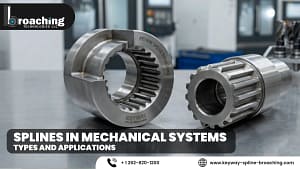
A spline is a series of ridges or teeth cut along a shaft or into a bore. The shaft teeth mesh with matching grooves in a mating component. Together they lock rotationally – meaning torque transfers directly – while sometimes allowing axial movement along the shaft length.
Think of it like a key and keyway but distributed evenly around the entire shaft circumference. Instead of one rectangular key taking all the load, dozens of teeth share it. That distribution is what makes splines in mechanical systems so much stronger and more reliable than single-key connections under heavy or reversing loads.
At Keyway Spline Broaching, cutting precise splines is core work – internal and external, across a wide range of specifications and materials.
Why Splines Are Used Instead of Keys
Good question. Keys are simpler and cheaper. Why use splines at all?
Here’s the honest answer:
Keys concentrate stress. All the torque load goes through one small contact point. Under high or reversing loads, keys and keyways fatigue and fail.
Splines distribute load. Twelve teeth sharing the load is fundamentally stronger than one key carrying it alone. The shaft and hub both last longer.
Splines allow axial movement. A keyed connection is fixed axially. Many splined connections allow the shaft to slide in and out of the hub while still transmitting torque. Driveshafts are a classic example – they need to change length as suspension moves.
Splines self-centre. The even tooth distribution keeps components perfectly centred. Keys can allow slight eccentric loading that causes vibration over time.
For light loads and simple applications, a key works fine. For heavy loads, high speeds, reversing torque, or any application needing axial movement – splines in mechanical systems are the right answer.
Main Types of Splines
Not all splines are the same. Different applications need different tooth profiles. Here’s a breakdown of the main types:
Involute Splines
The most common type in modern engineering. The tooth profile follows an involute curve – the same geometry used in gear teeth.
Involute splines are strong, accurate, and self-centering. They tolerate slight misalignment without binding. They’re standardised under ANSI and ISO specifications, which makes them easy to specify and source.
Used heavily in automotive transmissions, aerospace drives, and industrial gearboxes.
Straight-Sided Splines
Older design. The tooth sides are flat rather than curved. Simpler to produce on older machinery but less strong under high loads than involute profiles.
Still used in older equipment, agricultural machinery, and applications where loads are moderate and replacement parts need to match legacy designs.
Serrations
Fine-pitch splines with a triangular tooth profile. Used for permanent or semi-permanent connections where axial movement isn’t needed.
Common in steering columns, small shafts, and hand tool drives. The fine teeth grip tightly and resist loosening under vibration.
Helical Splines
The teeth run at an angle along the shaft – like a helix – rather than straight. This creates a smoother load transfer and reduces noise and vibration.
Used in high-speed applications and anywhere noise reduction matters. More complex and more expensive to produce than straight involute splines.
Ball Splines
A specialised type using recirculating ball bearings running in spline grooves. Very low friction. Very smooth axial movement. Used in precision linear motion systems, CNC machinery, and robotics where precise movement with minimal resistance is critical.
Spline Specifications – What the Numbers Mean
Splines are specified by a set of parameters. Understanding them helps when reading engineering drawings or ordering components.
| Parameter | What It Defines |
| Number of teeth | How many spline teeth around the shaft |
| Pitch (DP or Module) | Tooth size – affects strength and fit |
| Pressure angle | Tooth profile angle – 30° and 45° are common |
| Major diameter | Outer diameter of the splined section |
| Minor diameter | Root diameter of the splined section |
| Fit class | How tight or loose the mating fit is |
| Length of engagement | How far the spline meshes axially |
These parameters are standardised in ANSI B92.1 for inch splines and ISO 4156 for metric splines. Specifying to these standards ensures mating components from different manufacturers fit correctly.
The American National Standards Institute maintains the standards that govern involute spline specifications – essential reference for any engineer designing or procuring splined components.
How Splines Are Manufactured
Several manufacturing methods produce splines. The right choice depends on quantity, material, tolerance, and tooth profile.
Broaching
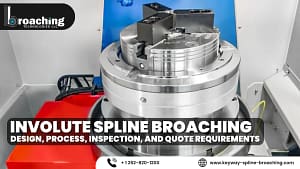
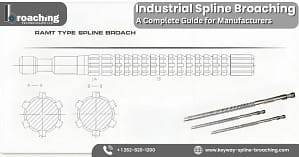
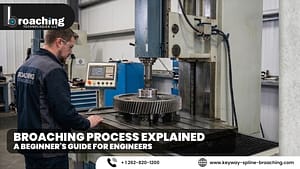
The fastest and most accurate method for internal splines. A broaching tool with progressively larger teeth is pulled through a bore in a single pass. The result is a finished spline to tight tolerance with excellent surface finish.
High production volumes. Consistent results. The preferred method for automotive and aerospace internal splines.
Hobbing
Used for external splines. A hob – a specialised rotating cutting tool – generates the tooth profile as the shaft rotates. Very accurate. Suitable for both small and large production runs.
Milling
Used for prototype work and small quantities. A milling cutter generates each tooth space individually. Slower than broaching or hobbing but flexible – no special tooling needed for small runs.
Grinding
Used after hardening to restore tolerance and surface finish that heat treatment distorts. Grinding produces the tightest tolerances and the best surface quality – essential for aerospace and high-precision applications.
Rolling
Cold forming rather than cutting. Spline teeth are pressed into the shaft using hardened dies. The process workhardens the surface – increasing fatigue strength. No material is removed. Fast and strong. Common for automotive driveshafts.
Broaching Technologies uses broaching to produce internal splines with the consistency and precision that production and prototype work both demand.
Applications of Splines in Mechanical Systems
Splines in mechanical systems appear across almost every engineering sector. Here’s where they do the most important work:
Automotive Drivelines
Transmission output shafts. Driveshafts. Differential input shafts. Wheel hubs. The entire power transmission path from engine to wheel uses splined connections at multiple points. Automotive splines need to handle high torque, reversing loads, and constant movement – often for hundreds of thousands of miles.
Aerospace
Flight control actuators. Engine accessory drives. Landing gear systems. Helicopter rotor heads. Aerospace splines operate under extreme loads and tight tolerances. Failure is not an option. Every spline in an aircraft application is manufactured and inspected to strict standards.
Industrial Gearboxes and Power Transmission
Electric motors connect to gearboxes via splined input shafts. Gearbox output shafts connect to driven equipment the same way. Industrial applications run continuously under load – the strength and reliability of splined connections keep production lines moving.
Agricultural Machinery
Power Take-Off (PTO) shafts on tractors and implements use standardised splined connections. These see high torque, shock loads, and constant engagement and disengagement. Standardisation means implements from different manufacturers connect to the same tractor PTO.
Construction Equipment
Excavator slew rings. Hydraulic motor drives. Track drive gearboxes. Construction machinery works in extreme conditions – heavy loads, shock, vibration, contamination. Splined connections handle it all without the fatigue failures that key connections would suffer.
Machine Tools and CNC Equipment
Spindle drives. Tool changers. Rotary tables. Precision machine tools need accurate, backlash-free connections. Splines – particularly ground involute splines – provide that precision consistently.
Robotics and Automation
Joint actuators in industrial robots use splined connections between motors, gearboxes, and output links. The combination of high torque capacity and precise positioning that splines provide makes them ideal for robotic applications where accuracy and repeatability are everything.
Common Problems With Splined Connections – And Why They Happen
Even well-designed splines fail sometimes. Here’s what goes wrong and why:
Fretting wear. Micro-movement between mating spline teeth – even thousandths of an inch – causes surface damage over time. More common in splines that are nominally fixed but experience slight load reversals. Proper fit selection and lubrication reduce this significantly.
Fatigue cracking. Usually at the root of spline teeth where stress concentrations are highest. Often caused by overloading, poor surface finish at the root, or inadequate case hardening depth.
Incorrect fit. Too loose and teeth rock – causing fretting and impact loads. Too tight and assembly is difficult and disassembly can damage components. Fit class selection needs to match the application.
Corrosion. Splines exposed to moisture without adequate lubrication or surface protection corrode. Corrosion roughens tooth surfaces and accelerates wear dramatically.
Misalignment. Excessive angular or parallel misalignment at a splined connection creates uneven load distribution across the teeth. Involute splines tolerate slight misalignment better than straight-sided types – but all splines have limits.
FAQs About Splines in Mechanical Systems
What’s the difference between a spline and a keyway?
A keyway uses one key to transmit torque. A spline uses multiple teeth distributed around the shaft – much stronger under high or reversing loads.
Can splines allow axial movement?
Yes – sliding splines are specifically designed for this. Fixed splines lock axially. The application determines which type is needed.
What material are splines made from?
Usually medium or high carbon steel, alloy steel, or stainless steel. Material choice depends on load, environment, and whether heat treatment is required.
What tolerance is achievable with broached internal splines?
Broaching typically achieves tolerances of ±0.001 inch or better on tooth form and spacing, with excellent surface finish.
Do splines need lubrication?
Sliding splines always need lubrication. Fixed splines benefit from it too – especially in applications with any micro-movement or vibration.
How do I specify the right spline for my application?
Start with the torque load, shaft diameter, material, and whether axial movement is needed. A specialist manufacturer can work from there to specify tooth count, pitch, pressure angle, and fit class.
Conclusion
From car driveshafts to aircraft actuators, from industrial gearboxes to surgical robots – splines in mechanical systems are the connection that makes reliable power transmission possible under real-world conditions. They distribute load across multiple teeth, allow controlled axial movement where needed, and self-centre mating components with a precision that no key connection can match. Understanding the types, the specifications, and the manufacturing methods behind splines helps engineers make better decisions at the design stage and avoid the failures that come from wrong fit selection or poor manufacturing quality.
Whether the application is high-volume automotive production or a one-off precision component, getting the spline right is what makes everything connected to it work properly. For precision broached splines made to specification, splines in mechanical systems start with the right manufacturing partner – and that’s exactly what Keyway Spline Broaching is built to be.