Spline broaching is a precision machining process that comes up constantly in mechanical engineering and manufacturing conversations, yet a surprising number of people outside the machining world have never heard of it. I remember the first time I watched a broaching operation on a splined shaft component.
The tool passed through the workpiece in one clean stroke and what came out the other end was a perfectly formed spline profile, accurate and repeatable in a way that would have taken significantly longer to achieve through any other method. That moment made it very clear why this process has been a cornerstone of mechanical component manufacturing for decades. At Keyway Spline Broaching, spline broaching is what we do every day and we understand both the technical requirements and the practical demands this process places on tooling, equipment, and expertise.
What Spline Broaching Actually Is
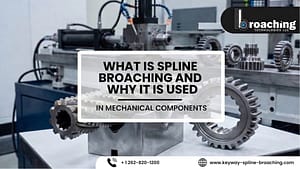
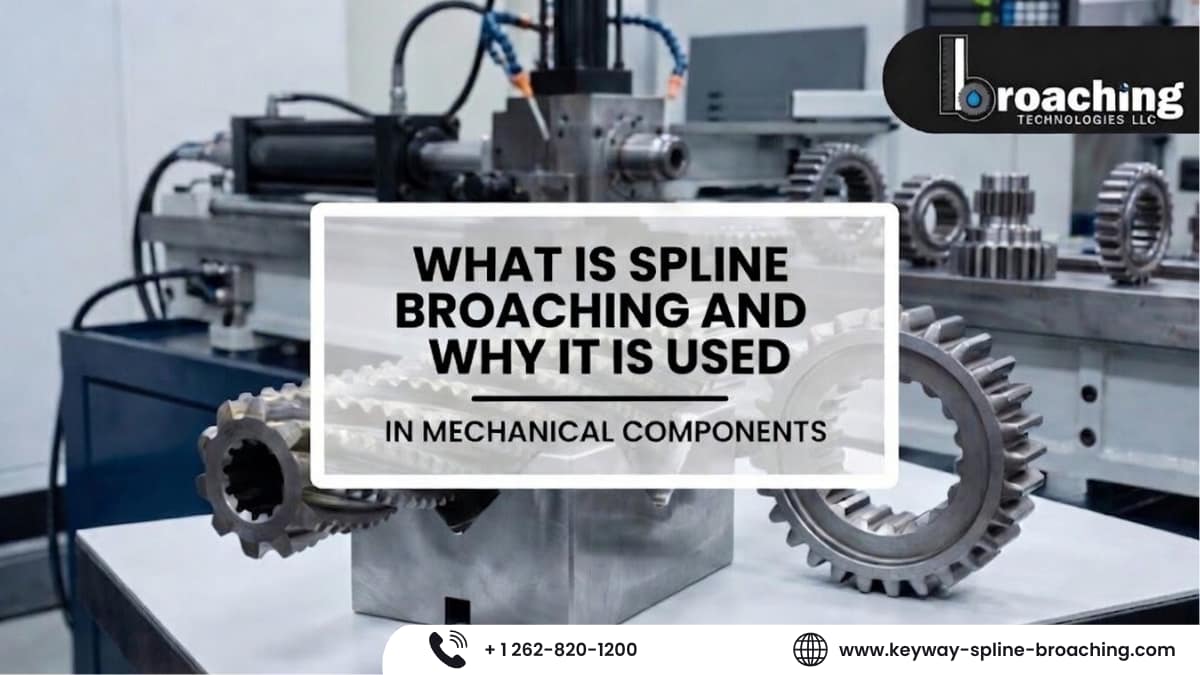
Spline broaching is a machining process where a multi-toothed cutting tool called a broach gets pushed or pulled through or across a workpiece to cut a spline profile. Each successive tooth on the broach removes a small amount of material. By the time the tool completes its stroke, the full spline form has been cut to the required specification.
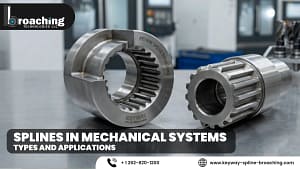
The process works for both internal splines, cut inside a bore, and external splines, cut on the outside surface of a shaft or hub. Internal spline broaching is more common in production environments because it produces profiles that are very difficult to achieve efficiently through other methods.
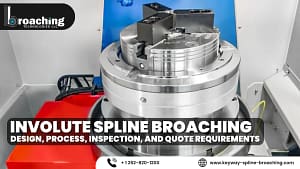
The spline profile produced can be involute, straight-sided, serrated, or other forms depending on what the application requires. Each profile type has different tooling requirements but the fundamental broaching process is the same across all of them.
How Spline Broaching Differs From Other Spline Cutting Methods
Several methods exist for cutting splines in mechanical components. Understanding how broaching compares to the alternatives helps explain why it gets chosen for specific applications.
| Method | Cycle Time | Accuracy | Best Application | Tooling Cost |
| Broaching | Very fast | Excellent | High volume production | High upfront, low per-part |
| Hobbing | Moderate | Very good | External splines, gears | Moderate |
| Milling | Slow | Good | Low volume, prototypes | Low to moderate |
| Grinding | Slow | Excellent | Hardened materials, tight tolerances | High |
| EDM | Very slow | Excellent | Hard materials, complex profiles | High |
Broaching stands out clearly on cycle time and accuracy for production volumes. The speed advantage compounds dramatically over large production runs and the consistency of the cut stays high from the first part to the last.
Why Splines Are Used in Mechanical Components
Before going deeper into the broaching process itself, it helps to understand why splines exist and what function they serve in mechanical systems.
A spline is a series of ridges or teeth on a shaft that mesh with corresponding grooves in a mating component. This interlocking connection transmits torque between the shaft and the hub, gear, or other component it connects to. Unlike a simple key and keyway arrangement, a spline distributes torque across multiple contact points simultaneously. That distribution reduces stress concentration, allows higher torque transmission, and provides a more robust connection under dynamic loading conditions.
Splines also allow axial movement along a shaft while maintaining torque transmission. That sliding capability is essential in applications like automotive driveshafts, gearbox components, and hydraulic systems where components need to move along the shaft axis during operation.
At Keyway Spline Broaching, we produce splined components for applications across automotive, aerospace, industrial machinery, and power transmission sectors. The requirements vary significantly between those applications but the need for accuracy and consistency is constant across all of them.
The Spline Broaching Process Step by Step
Understanding what actually happens during a spline broaching operation gives a clearer picture of why the process delivers such consistent results.
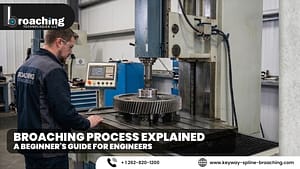
The workpiece gets loaded into the broaching machine and positioned accurately relative to the broach. The broach tool is aligned with the bore or surface to be cut. The machine then drives the broach through or across the workpiece in a single controlled stroke.
As the broach moves through the material, each successive tooth cuts slightly deeper than the one before it. The progressive cutting action distributes the total material removal across many teeth rather than concentrating it at a single point. That distribution reduces cutting forces per tooth and contributes to the long tooling life that broaching is known for.
The cut is complete at the end of the stroke. The workpiece gets unloaded and the next one takes its place. The cycle repeats with each part receiving an identical cut because the tool geometry defines the final form and doesn’t change between strokes.
Industries and Applications Where Spline Broaching Is Used
Spline broaching shows up wherever mechanical systems need reliable torque transmission through splined connections.
Automotive manufacturing is the largest single application area. Transmission components, differential assemblies, driveshaft connections, and steering system components all commonly use splined profiles that get broached during production. The volumes involved in automotive manufacturing make broaching’s speed and consistency advantages particularly valuable.
Aerospace and defense applications require splined components in flight control systems, landing gear mechanisms, and engine accessory drives. The accuracy requirements in these applications are stringent and the consequences of component failure are severe. Broaching delivers the precision and repeatability these applications demand.
Industrial gearboxes and power transmission equipment uses splined connections throughout. Gearbox input and output shafts, coupling hubs, and sprockets all commonly use broached splines. The torque levels in industrial power transmission put significant demands on the splined connection and the accuracy of the broached profile directly affects how well the connection performs under load.
Agricultural and construction equipment operates under heavy and often variable loading conditions. Splined connections in these machines have to withstand abuse that would destroy less robust connection methods. Broached splines handle those conditions reliably when the profile is cut correctly and the fit between mating components is within specification.
According to the Society of Manufacturing Engineers, broaching remains one of the most efficient processes for producing precision internal profiles in medium to high volume production environments, a recognition that reflects decades of consistent performance across industrial applications.
Tooling Considerations in Spline Broaching
The broach tool is the most significant cost element in setting up a spline broaching operation and understanding what affects tooling selection and performance matters for anyone specifying this process.
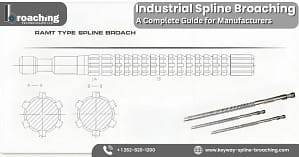
Broach tools are custom designed for the specific spline profile being cut. The tooth geometry, tooth pitch, rise per tooth, and overall tool length all get calculated based on the workpiece material, the spline specification, and the required surface finish. A broach designed for one spline profile cannot be used for a different profile, which is why tooling lead time and cost are relevant considerations when evaluating broaching for a new component.
Tooling life in spline broaching is genuinely long compared to many other machining processes. The distributed cutting action across many teeth means no single tooth carries the full cutting load and wear progresses gradually rather than concentrating at one point. A well-maintained broach tool produces thousands of parts before resharpening becomes necessary.
Material hardness affects tooling requirements significantly. Broaching works well across a range of materials from aluminum and brass through to medium-hardness steels. Very hard materials may require grinding or EDM for the spline cutting operation, though some harder materials can be broached with appropriate tooling specifications.
Keyway Spline Broaching maintains a broad tooling inventory for common spline profiles and works with tooling manufacturers for custom profiles when standard tooling doesn’t cover the required specification.
FAQs
Q: What is the difference between a spline and a keyway?
A: A keyway uses a single key engaging a single groove to transmit torque. A spline uses multiple teeth engaging multiple grooves simultaneously, distributing torque across more contact area and allowing higher torque transmission with lower stress concentration.
Q: How accurate are broached splines?
A: Broaching holds tight dimensional tolerances consistently across production runs. The tool geometry defines the final profile and dimensional consistency from part to part is one of the primary advantages of the process.
Q: What spline standards can be broached?
A: Common standards including involute splines to ANSI B92.1, DIN 5480, and straight-sided splines to DIN 5462 can all be produced by broaching with appropriate tooling.
Q: How long does broach tooling last?
A: A well-maintained broach tool typically produces thousands of parts before resharpening is needed. Actual life depends on workpiece material, spline dimensions, and cutting conditions.
Q: Is broaching suitable for prototype or low-volume spline work?
A: Broaching becomes most cost effective at medium to high volumes because of tooling costs. For prototypes and very low volumes, milling or EDM may be more economical despite slower cycle times.
Conclusion
Spline broaching is a process that combines speed, accuracy, and consistency in a way that few other machining methods match for the right applications. The ability to produce precise splined profiles repeatedly at high volume, with long tooling life and minimal setup time between batches, makes it the natural choice for manufacturers who depend on splined connections throughout their products. From automotive transmissions to industrial gearboxes to aerospace components, the demand for accurately broached splines runs through almost every sector of mechanical manufacturing. If your production requires splined components and you want to understand what spline broaching can deliver for your specific application, visit Keyway Spline Broaching and talk to a team that brings genuine expertise and hands-on experience to every spline broaching job they take on.