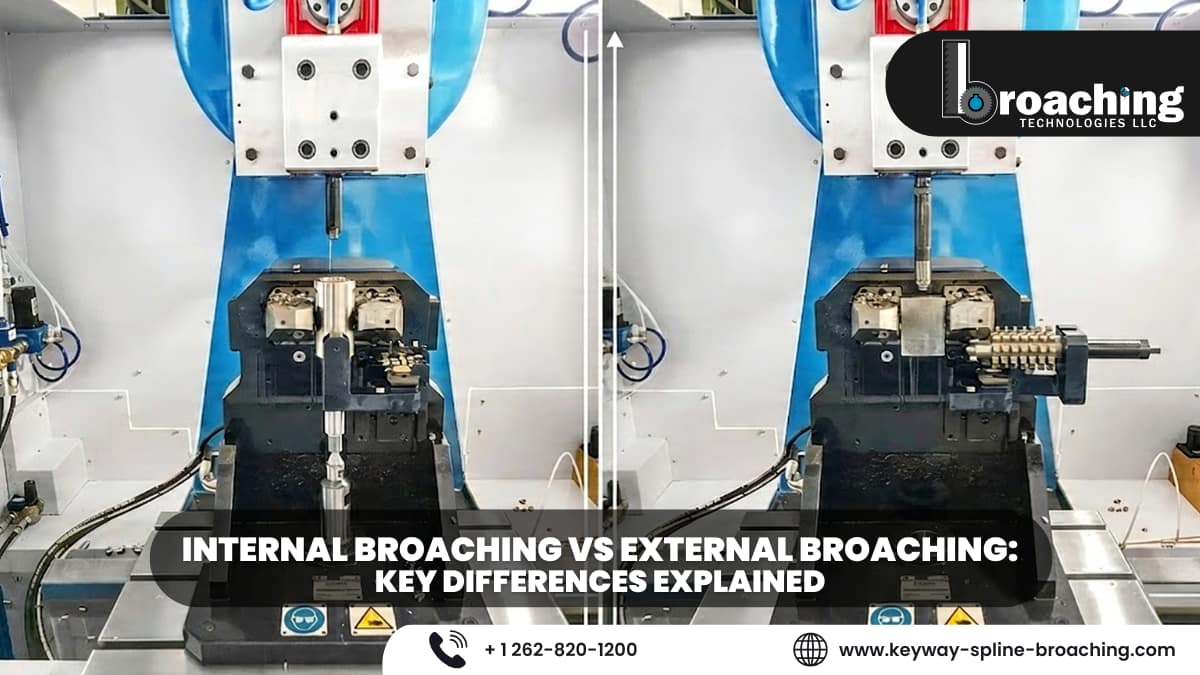
Internal broaching vs external broaching is a comparison that comes up regularly when engineers and procurement teams are specifying machined components for the first time and trying to understand which process applies to their situation.
The terminology sounds technical but the underlying distinction is straightforward once someone explains it clearly. One process cuts features inside a workpiece. The other cuts features on the outside surface.
Both use the same fundamental broaching principle but the tooling, the machine setup, and the applications are different enough that understanding each one separately helps engineers make better decisions about which to specify and when. At Keyway Spline Broaching, we run both types of operations regularly and the questions we get from engineers and buyers confirm that a clear explanation of the differences genuinely helps people work with us more effectively.
What Internal Broaching Is
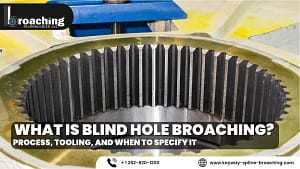
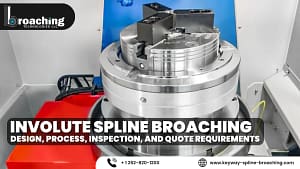
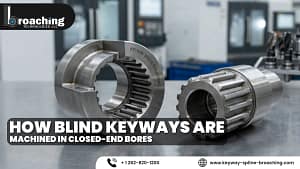
Internal broaching cuts profiles inside the bore of a workpiece. The broach tool passes through a pre-existing hole, reshaping and enlarging it to produce the required internal profile. Keyways, splines, square holes, hexagonal bores, and other internal shapes all get produced through internal broaching.
The workpiece needs to have a pilot hole already present before internal broaching begins. That hole guides the broach tool at entry and provides the starting geometry that the broach teeth work outward from as the tool passes through.
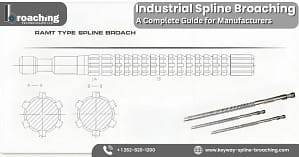
The broach itself is a long slender tool that fits through the pilot hole. Its teeth progressively cut deeper from the first tooth to the last, with the final finishing teeth bringing the internal profile to the required dimension and surface finish in a single pass.
Internal broaching is the more common of the two processes in production environments. The ability to produce precise internal splines and keyways in a single fast stroke makes it the standard approach for high-volume transmission components, gearbox parts, and power transmission hubs across automotive and industrial manufacturing.
At Keyway Spline Broaching, internal broaching for keyways and splines makes up the majority of our production work. The consistency and speed the process delivers across high-volume runs is why customers keep coming back to us for repeat orders on the same components.
What External Broaching Is
External broaching cuts profiles on the outside surface of a workpiece. The broach tool moves across the external surface rather than through a bore, removing material from the outer geometry of the component to produce flat surfaces, external splines, serrations, slots, or shaped profiles.
The workpiece in external broaching is held stationary while the broach tool moves past it, or in some continuous broaching setups the workpiece moves past a stationary broach. Either way the cutting action is the same. Progressive teeth remove material from the external surface until the finished profile is complete.
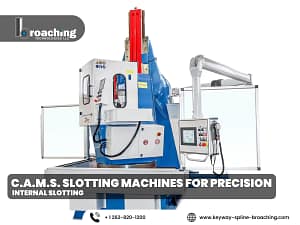
External broaching requires different machine configurations than internal broaching because the tool needs to move across or past the workpiece rather than through it. Vertical broaching machines, horizontal broaching machines, and continuous surface broaching lines all get used for external applications depending on the component size and production volume.
Key Differences Between Internal and External Broaching
Here is a direct comparison of the most important differences between the two processes:
| Factor | Internal Broaching | External Broaching |
| Feature location | Inside a bore | Outside surface |
| Pilot hole required | Yes | No |
| Common profiles | Keyways, splines, polygons | Flat surfaces, external splines, slots |
| Tool design | Long slender broach through bore | Broach moves across surface |
| Machine type | Vertical or horizontal pull/push | Surface broaching machine |
| Typical applications | Transmission hubs, gears, couplings | Engine components, turbine parts |
| Tooling cost | High, custom per profile | High, custom per profile |
| Cycle time | Very fast, single stroke | Fast, single pass |
| Volume suitability | Medium to high volume | Medium to high volume |
Both processes share the fundamental broaching advantage of completing the cut in a single stroke or pass, which is what gives broaching its speed advantage over milling and other multi-pass machining methods.
Applications Where Internal Broaching Is the Right Choice
Internal broaching is specified when the required feature sits inside a bore and needs to be produced with high dimensional consistency across a production run.
Automotive transmission components are the largest single application area for internal broaching globally. Gear hubs, input shaft bores, differential components, and steering column splines all commonly use internal broached profiles. The volumes involved in automotive production make the speed and consistency of internal broaching essential.
Power transmission couplings and hubs use internal keyways and splines to connect rotating components to shafts. The torque transmission requirements of these connections demand tight dimensional accuracy that internal broaching delivers consistently.
Hydraulic and pneumatic components use precision internal profiles for valve bodies, actuator components, and cylinder bores. Internal broaching produces these profiles at the accuracy levels hydraulic system performance requires.
Agricultural and construction equipment uses internally broached splines throughout drivetrain and power takeoff systems. These components operate under heavy loading conditions and the dimensional consistency of broached profiles directly affects how reliably they perform in service.
According to the Society of Manufacturing Engineers, internal broaching remains one of the most efficient methods for producing precision internal profiles in medium to hard materials at production volumes where cycle time and dimensional consistency are both critical requirements.
Applications Where External Broaching Is the Right Choice
External broaching is specified when features need to be produced on the outside surface of a component and the geometry is suited to a straight-line broaching stroke.
Automotive engine components use external surface broaching for flat surface features on cylinder blocks, connecting rod caps, and other components where precise flat mating surfaces need to be produced at high volume efficiently.
Turbine and aerospace components use external broaching for fir tree profiles, serrations, and other shaped external features on turbine discs and blade root forms. The accuracy requirements in aerospace applications are demanding and external broaching delivers the dimensional precision and consistency these parts require.
Industrial gearbox components use external splines on output shafts and other transmission elements. External broaching produces these profiles with the dimensional accuracy required for proper mating with internally splined components.
Cutting and forming tool manufacturing uses external broaching to produce precise external profiles on tool bodies that need to fit accurately into machine tool holders and fixtures.
Tooling Considerations for Both Processes
Both Internal broaching vs external broaching use custom tooling designed for the specific profile being cut. This is an important consideration for anyone specifying either process for the first time.
A broach tool is not a general-purpose cutting tool. It is designed and manufactured for one specific profile in one specific material at one specific dimension. Changing the profile, the material, or the dimension typically requires new tooling.
This makes tooling cost a significant factor in the economics of both internal and external broaching. The investment in tooling only makes financial sense when it can be spread across enough parts to bring the per-part tooling cost to an acceptable level.
At low volumes the tooling cost per part is too high for broaching to compete with milling or EDM on cost grounds even though it wins on cycle time and consistency.
Tooling life is genuinely long in both processes. The distributed cutting action across many teeth means no single point carries the full cutting load and wear progresses gradually. A well-maintained broach handles thousands of parts before resharpening becomes necessary.
Keyway Spline Broaching maintains a broad inventory of tooling for common internal keyway and spline profiles. Custom tooling is available for profiles outside our standard range with lead times that depend on the complexity of the profile and the specification requirements.
How to Choose Between Internal broaching vs external broaching
The choice between Internal broaching vs external broaching isn’t really a choice in most cases because the feature location determines which process applies. Internal features require internal broaching. External features require external broaching. The decision that engineers actually face is whether broaching is the right process at all for their specific application.
Broaching makes sense when production volume is sufficient to justify tooling investment, when the feature geometry is a straight profile accessible by a straight-moving tool, and when dimensional consistency across the production run is important.
Broaching doesn’t make sense for very low volumes, for complex curved profiles, or for materials at the extreme hard end of the hardness range where tooling life becomes very short.
FAQs
Q: Can Internal broaching vs external broaching be done on the same machine?
A: Generally no. Internal and external broaching use different machine configurations. Some versatile broaching machines can handle both with appropriate fixturing but dedicated machines are more common in production environments.
Q: What tolerances can internal broaching hold?
A: Internal broaching routinely holds tolerances of plus or minus 0.001 inches or better. The tool geometry defines the finished profile and dimensional consistency from part to part is one of the primary advantages of the process.
Q: Is external broaching faster than milling for external profiles?
A: For production volumes where tooling cost is justified, yes. A single broaching pass produces the finished profile in seconds compared to the multiple passes milling requires.
Q: Can hardened components be broached internally or externally?
A: Generally broaching is performed before heat treatment. Post-hardening profile finishing is typically done by grinding. Moderately hard materials can be broached but very hard workpieces are not suitable.
Q: What is the minimum production volume that justifies broaching tooling investment?
A: It depends on the profile complexity and tooling cost but most broaching operations become economically favorable at batch sizes of several hundred parts or more. Higher tooling costs require higher volumes to justify the investment.
Q: How long does custom broach tooling take to manufacture?
A: Lead times vary with profile complexity and tooling specifications. Simple profiles from well-equipped tooling suppliers can be ready in a few weeks. Complex profiles may take longer.
Conclusion
Internal broaching vs external broaching comes down to where the feature sits on the component and what profile needs to be produced. Internal broaching cuts inside bores to produce keyways, splines, and other internal profiles with exceptional speed and dimensional consistency. External broaching cuts profiles on outside surfaces for flat features, external splines, and shaped forms at the same fundamental efficiency.
Both processes share the speed and consistency advantages that make broaching the production method of choice for the right applications at the right volumes. Understanding which process applies to your component and whether the volume and geometry justify the tooling investment is the starting point for any broaching specification decision. If you have components that require internal or external broached profiles and want to discuss feasibility, tooling options, or production planning, visitKeyway Spline Broaching and talk to a team that understands internal broaching vs external broaching from hands-on production experience and can help you get the right process specified for your application.