Manufacturing precision parts is hard work. Tolerances are tight. Shapes are complex. And time on the machine costs money. That’s exactly why broaching tools exist. They cut precise shapes into metal in a single pass – keyways, splines, round holes, flat surfaces – clean and accurate every time. No second guessing.
No multiple setups. Just one smooth cut that hits the spec. This guide covers everything you need to know about broaching tools – what types exist, how they’re designed, and where they get used in real manufacturing.
What Are Broaching Tools
A broaching tool is a long, toothed cutting tool. Each tooth is slightly larger than the one before it. As the tool moves through or across a workpiece, each tooth removes a small amount of material. By the end of the stroke, the full shape is cut – clean, accurate, and finished.
It sounds simple. In practice, it’s one of the most precise metal cutting methods available.
Broaching tools work on metals, plastics, and some composites. They cut internal shapes like keyways and splines. They cut external shapes like flat surfaces and gear teeth. And they do it faster than almost any other machining method for the same job.
At Keyway Spline Broaching, broaching is the core of what we do – precision cuts for parts that have to be exactly right.
How Broaching Works – The Basic Idea
Every broaching tool has a row of cutting teeth. The teeth increase in size from front to back. Each one cuts a little deeper than the last.
The tool is either pushed or pulled through the workpiece – or across it, depending on the type. Each tooth takes its bite. By the time the last tooth passes through, the shape is complete.
One pass. Full depth. Finished surface.
That’s the core advantage. Other machining methods need multiple passes to reach final depth. Broaching gets there in one.
Types of Broaching Tools
Not all broaching tools are the same. Different jobs need different designs. Here’s a breakdown of the main types:
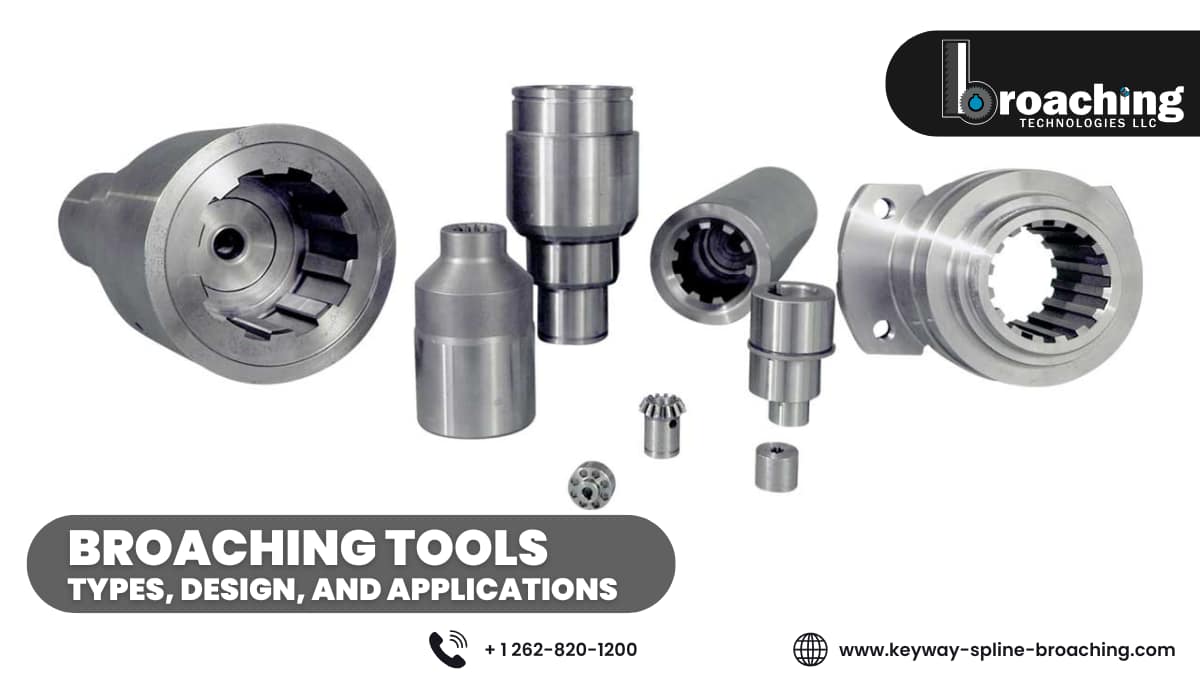
Internal Broaching Tools
These cut shapes inside a hole or bore.
Keyway broaches cut the rectangular slot inside a hub or gear that accepts a key. This is one of the most common broaching jobs in manufacturing.
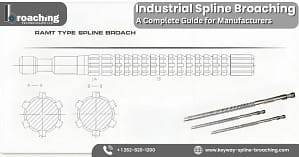
Spline broaches cut multiple teeth around the inside of a bore – used in gearboxes, drive shafts, and power transmission components.
Round broaches enlarge and finish a round hole to exact diameter and surface quality.
Hex and square broaches cut internal hex or square shapes – used for sockets, drive components, and specialty fasteners.
External Broaching Tools
These work on the outside surface of a part.
Surface broaches cut flat, contoured, or stepped surfaces in a single pass. Used heavily in automotive and aerospace manufacturing.
Pot broaches surround the workpiece and cut the external shape – commonly used for external splines and gear forms.
Specialty Broaching Tools
Straddle broaches cut two parallel surfaces at the same time. Saves time. Keeps surfaces perfectly parallel.
Continuous broaches are used on rotary broaching machines – the workpiece moves past a fixed broach continuously. Great for high-volume production.
Broaching Tool Design – What Makes a Good One
Design separates a broaching tool that lasts from one that fails early. Here’s what matters:
| Design Element | What It Does |
| Tooth pitch | Controls chip load and cutting pressure |
| Rake angle | Affects how smoothly each tooth cuts |
| Clearance angle | Prevents the tool from rubbing after cutting |
| Rise per tooth | Determines how much material each tooth removes |
| Tooth gullet depth | Controls chip storage between teeth |
| Surface finish on teeth | Directly affects the finish on the workpiece |
Every one of these has to be right for the material being cut and the shape being produced. A broach designed for aluminium won’t perform well on hardened steel. A broach for a keyway won’t work for a spline.
Good design starts with knowing the job completely – material, tolerance, surface finish requirement, production volume, and machine type.
The Society of Manufacturing Engineers publishes technical standards and research on broaching tool design and application – a solid reference for anyone specifying or procuring precision broaching tools.
Materials Used in Broaching Tools
The cutting material affects how long the tool lasts and what it can cut.
High Speed Steel (HSS)
The most common material for broaching tools. Good toughness. Handles interrupted cuts well. Can be resharpened multiple times. Works on most metals.
Carbide
Harder than HSS. Holds a sharper edge longer. Better for high-volume production and harder materials. More brittle – needs a stable setup and clean cutting conditions.
Cobalt HSS
A step up from standard HSS. Better heat resistance. Good choice for tougher alloys and stainless steels where standard HSS wears too fast.
Coatings
TiN, TiCN, and TiAlN coatings extend tool life significantly. They reduce friction, resist heat, and protect the cutting edge – especially valuable in high-volume production runs.
Applications – Where Broaching Tools Get Used
Broaching tools show up in almost every area of precision manufacturing. Here’s where they do the most work:
Automotive Manufacturing
Keyways in crankshafts, camshafts, and transmission gears. Splines in driveshafts and differential components. Internal shapes in brake and steering parts. Automotive is one of the biggest users of broaching in the world.
Aerospace
Turbine disc slots – called fir tree slots – are broached to tight tolerances. So are internal splines in flight control components and structural fastener holes in airframe parts. Aerospace broaching demands extreme precision and surface quality.
Power Generation
Turbine components, generator shafts, pump impellers – all use broached keyways and splines. Power generation equipment runs under heavy load. The cuts have to be right.
Agricultural and Heavy Equipment
Gearboxes, PTO shafts, and drive components in farm and construction machinery all use broached splines and keyways. These parts take hard use. Precision matters for longevity.
General Engineering and Job Shops
One-off parts, prototype work, repair jobs – broaching tools handle these too. Not every broaching job is high volume. Sometimes a single precise cut is all that’s needed.
Keyway Spline Broaching works across all of these applications – from single prototype parts to ongoing production runs that need consistent results every time.
Internal vs External Broaching – Quick Comparison
| Feature | Internal Broaching | External Broaching |
| Cuts | Inside bores and holes | Outside surfaces |
| Common shapes | Keyways, splines, hex, round | Flats, slots, gear forms |
| Setup complexity | Moderate | Low to moderate |
| Common industries | Automotive, aerospace, power | Automotive, general engineering |
| Typical tolerance | ±0.001 inch or better | ±0.001 inch or better |
Both types achieve excellent tolerances. The choice depends entirely on where the cut needs to happen.
Common Problems With Broaching Tools – And What Causes Them
Even good tools run into trouble. Here’s what goes wrong and why:
Premature tooth wear. Usually caused by cutting too hard a material without the right tool specification. Or running without proper cutting fluid.
Chipping on cutting edges. Often from interrupted cuts, incorrect rake angle, or too brittle a tool material for the job.
Poor surface finish on the cut. Can come from worn teeth, incorrect rise per tooth, or inadequate chip clearance causing built-up edge.
Tool breakage. Usually from pushing too hard, incorrect alignment, or using a worn tool past its useful life.
Most problems trace back to using the wrong tool for the job or running it past its service life. Regular inspection and proper tool specification prevent most of these issues.
FAQs About Broaching Tools
What materials can broaching tools cut?
Most metals include steel, aluminium, brass, bronze, cast iron, and titanium. Also some plastics and composites.
How long do broaching tools last?
Depends on material, volume, and maintenance. HSS tools can typically be resharpened 8 to 10 times before replacement.
Can broaching tools be resharpened?
Yes. HSS broaches are resharpened by grinding the face of the cutting teeth. Carbide broaches can also be resharpened but require specialised grinding equipment.
What tolerances can broaching achieve?
Typically ±0.001 inch or better. With precision tooling and good machine condition, tighter tolerances are achievable.
Is broaching suitable for small production runs?
Yes. While broaching shines in high-volume production, it’s also used for small batches and one-off jobs where precision is the priority.
Conclusion
Precision cuts don’t happen by accident. They come from the right tool, designed correctly, and used properly. Broaching tools deliver that precision consistently in a single pass across a wide range of shapes and materials. From keyways in automotive gearboxes to fir tree slots in aerospace turbines, the applications are broad and tolerances are tight.
Understanding tool types, design principles, and material choices helps you get better results and longer tool life. Whether you are specifying tools for high-volume production or a one-off precision part, the fundamentals stay the same. Get the design right, match the tool to the material, and maintain it properly for clean, accurate cuts every single time.