The broaching process is a machining method that engineers get to hear of early in their careers, presumably in a setting where someone thinks they already know what it is. A component with a drawing specification that calls for a broached keyway or a broached spline can be confusing when the junior engineer is nodding along and mentally noting “I’ll look it up later” . I recall that feeling myself.
The concept isn’t complicated once someone explains it clearly but the terminology and the variety of applications can make it seem more mysterious than it actually is. At Keyway Spline Broaching, we work with engineers at all experience levels and the questions we get about how the broaching process works tell us that a clear, practical explanation is genuinely useful for people coming to it fresh.
What the Broaching Process Is
The broaching process is a machining process in which a multi-toothed cutting implement, known as a broach, is pushed or pulled all over or through a work-piece. The size of each tooth on the broach increased slightly compared to the previous. As the tool progresses, the next tooth pulls off a small piece of material until the last tooth produces the required dimension and surface finish of the finished profile.
The full cut occurs in just one stroke. One pass of the broach through or across the workpiece and the feature is complete. That single-stroke completion is what makes broaching fundamentally different from milling or grinding where multiple passes build up to the finished dimension progressively.
The finished profile is defined entirely by the shape of the broach teeth. If the broach is shaped to produce an internal spline, the workpiece comes out with an internal spline. If it’s shaped for a keyway, the keyway comes out complete in one stroke. The dimensional accuracy of the finished feature depends on the accuracy of the broach tool rather than on machine settings or operator skill during the cut.
Types of Broaching Operations
The broaching process covers several distinct operation types depending on the feature being cut and the configuration of the machine and tooling.
Internal Broaching
Internal broaching cuts features inside a bore. Internal broaching creates fits such as keyways, splines, round holes, square holes, hexagon profile and so on. Broach tool passes through a predetermined hole in the workpiece and enlarges it to the required shape.
This is the most common broaching application in production environments. The ability to produce precise internal profiles in a single stroke at high speed makes internal broaching the method of choice for keyways and splines in high-volume manufacturing.
At Keyway Spline Broaching, internal broaching for keyways and splines makes up the majority of our production work across automotive, industrial, and power transmission component manufacturing.
External Broaching
External broaching cuts features on the outside surface of a workpiece. Flat surfaces, external splines, slots, and serrations can all be produced by external broaching. The broach tool moves across the external surface rather than through a bore.
External broaching is less common than internal but serves important applications in gear manufacturing, turbine component production, and other areas where precise external profiles need to be produced at volume.
Surface Broaching
Surface broaching removes material from flat or contoured external surfaces. It produces flat, grooved, or shaped surfaces with high accuracy and good surface finish. Automotive engine components like cylinder blocks use surface broaching for certain flat surface features during high-volume production.
Continuous Broaching
Continuous broaching moves workpieces past a stationary broach tool on a conveyor system. It’s used for high-volume production of external surface features where the same cut needs to be made on a continuous stream of parts.
How a Broach Tool Is Constructed
Understanding the construction of a broach tool helps make sense of how the process works mechanically.
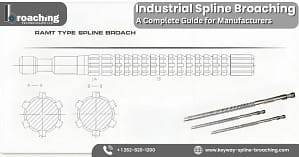
A broach consists of several distinct sections along its length. The front pilot aligns the tool with the workpiece before cutting begins. The roughing teeth do the bulk of the material removal. The semi-finishing teeth refine the profile. The finishing teeth bring the feature to final dimension and surface finish. The rear pilot supports the tool as it exits the workpiece.
Here is a breakdown of broach tooth terminology:
| Term | Definition |
| Rise per tooth | Amount of material each tooth removes |
| Pitch | Distance between consecutive teeth |
| Rake angle | Cutting face angle affecting chip formation |
| Clearance angle | Relief behind the cutting edge |
| Chip gullet | Space between teeth that holds chips during cutting |
| Land | Flat area behind cutting edge |
The rise per tooth is a critical design parameter. Too much rise per tooth overloads individual teeth and shortens tool life. Too little rise per tooth makes the tool unnecessarily long and reduces production efficiency. Getting this balance right is part of what separates well-designed broach tooling from tooling that causes problems in production.
Materials the Broaching Process Works On
The broaching process handles a wide range of engineering materials. Steel in various grades and heat treatment conditions, aluminum, brass, bronze, cast iron, and many engineering plastics all broach successfully with appropriate tooling specifications.
Material hardness affects tooling requirements significantly. Softer materials like aluminum and brass allow higher rise per tooth and faster production rates. Harder steel grades require more conservative tooling geometry and lower cutting speeds to maintain tool life at acceptable levels.
According to the Society of Manufacturing Engineers, broaching is recognized as one of the most efficient processes for producing precision internal profiles in medium to hard materials, particularly in production environments where cycle time and dimensional consistency are both critical requirements.
Very hard materials that have been through hardening and tempering to high hardness levels are generally not suitable for broaching. Post-hardening spline and keyway finishing in hardened components is typically done by grinding rather than broaching.
Advantages and Limitations of the Broaching Process
Every machining process has strengths and weaknesses. Understanding both helps engineers specify broaching appropriately rather than applying it where it isn’t the right tool.
Advantages:
Speed is the most significant advantage. A broaching cycle takes seconds rather than minutes. For high-volume production that speed advantage compounds into massive output differences compared to milling the same features.
Dimensional consistency is another major strength. Because the tool geometry defines the finished feature, every part comes out to the same dimension as long as the tooling is within specification. This consistency reduces inspection burden and scrap rates in production.
Long tooling life reduces per-part tooling costs significantly over production runs. The distributed cutting action across many teeth means no single point carries the full cutting load and wear progresses gradually.
Limitations:
Tooling cost is high upfront. A broach tool is custom-made for the specific profile being cut and represents a significant investment. This makes broaching economically unsuitable for very low volume work where the tooling cost can’t be amortized across enough parts.
The process only cuts in straight lines. Complex three-dimensional profiles or curved features can’t be produced by broaching. Features need to be accessible by a straight-moving tool.
Changes to the profile require new tooling. Unlike a milling machine where profile changes involve program modifications, a broached profile change means commissioning new tooling.
When to Specify the Broaching Process
Engineers choosing between machining methods for internal profiles need to consider a few key factors.
Production volume is the primary consideration. Broaching becomes cost-effective at medium to high volumes where the tooling investment gets spread across many parts. For prototype quantities or very small batches, milling is usually more economical despite slower cycle times.
Feature geometry determines whether broaching is feasible at all. If the feature is a straight internal keyway, spline, or polygon, broaching is a strong candidate. If the feature has curves, intersecting forms, or complex geometry, other methods may be necessary.
Tolerance requirements favor broaching when tight dimensional consistency across a production run is needed. The tool-defined geometry of broaching produces inherently consistent results that process-dependent methods like milling struggle to match over long runs.
Keyway Spline Broaching supports engineers through tooling specification and process planning for new components as well as providing production broaching services for established parts. Getting the process parameters right at the design stage prevents problems during production.
FAQs
Q: What is the minimum bore size that can be broached?
A: Internal broaching is practical for bores down to approximately 6mm diameter with appropriate tooling. Very small bores require specialized micro-broaching tooling and techniques.
Q: How accurate is the broaching process dimensionally?
A: Broaching routinely holds tolerances of plus or minus 0.001 inches or better for internal profiles. The tool geometry defines the finished dimension and consistency across a production run is one of the process’s primary strengths.
Q: How long does broach tooling last?
A: A well-maintained broach produces thousands of parts before resharpening is needed. Tool life depends on workpiece material, rise per tooth, cutting speeds, and lubrication conditions during cutting.
Is broaching a correct choice for prototype work?
Broaching is not economical for single parts or very small quantities due to tooling cost. It is usually easier to mill or EDM keyways and splines on prototypes and low volumes.
What lubricant is used in the broaching process?
A: For steel, either cutting oil or a sulphur-based cutting fluid is utilized. Lighter cutting oils are typically used on aluminum. Lubrication matters for surface finish quality and tool life.
Conclusion
The broaching process combines speed, accuracy and consistency in a way that makes it the ideal solution for the internal keyways, splines and more for other straight profile features in medium to high volume production. When engineers understand how the process that they specify really works, what advantages it can bring them and its limitations, they are able to specify correctly. Thus, they will also get the best results from it in production.
The shape of the tool determines the finished feature, while the single-stroke cycle ensures fast production. Moreover, the fact that cutting occurs simultaneously on several teeth means the life of the tool is really long, especially compared to other methods. If you’re working on a component that requires broached features and want to discuss tooling options, production feasibility, or process parameters, visit Keyway Spline Broaching and talk to a team that understands the broaching process from the ground up and applies that knowledge on production jobs every single day.