In the automotive industry, reliable power transmission is essential for vehicle performance, safety, and longevity. A vehicle’s drivetrain, including shafts, gearboxes, and couplings, must operate with precise alignment and efficiency. Even minor deviations in component geometry can result in vibration, noise, or premature wear.
Automotive broaching keyways have emerged as a critical manufacturing process for achieving this precision. By creating accurate keyways, manufacturers ensure optimal torque transfer between shafts and gears, enhancing overall drivetrain performance. This technology is particularly valuable in high-performance vehicles and heavy-duty applications where reliability and durability are paramount.
Broaching is no longer just a niche process—it has become a cornerstone of modern automotive manufacturing, ensuring components meet stringent tolerances and perform consistently under demanding conditions.
Understanding Automotive Broaching Keyways
What Are Keyways?
Keyways are slots or grooves cut into a shaft and a mating component (such as a gear or pulley) to accept a key. The key locks the components together, enabling torque transfer without slippage. In automotive applications, keyways must be manufactured with high precision to handle significant rotational forces, prevent vibration, and extend component life.
How Broaching Creates Precision Keyways?
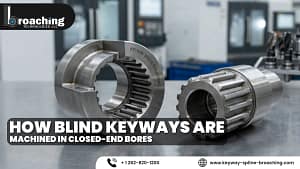
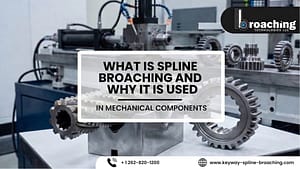
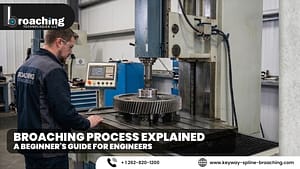
Broaching is a machining process that uses a toothed tool called a broach to remove material in a single pass. The broach progressively cuts the slot to the desired shape and depth, producing uniform and accurate features. This method is particularly suited for keyway production because it can maintain tight tolerances, even in hardened steel or other automotive-grade materials.
Benefits of Broaching for Keyways:
- Consistent geometry and precise depth
- Smooth surface finish, reducing stress concentrations
- Ability to cut hard or tough materials efficiently
Compared to milling or shaping, broaching offers superior accuracy, making it the preferred choice for automotive keyways, shafts, and splined components.
Applications of Automotive Broaching Keyways
Shaft Broaching in Powertrains
Shafts are central to transmitting power from the engine to the wheels. Broaching ensures that keyways on shafts are accurately aligned and dimensioned, allowing seamless coupling with gears and pulleys. Misalignment or imprecise keyways can lead to uneven load distribution, vibration, and premature component failure.
High-precision shaft broaching guarantees:
- Optimal torque transfer
- Reduced mechanical stress
- Enhanced component lifespan
Spline Broaching in Gearboxes
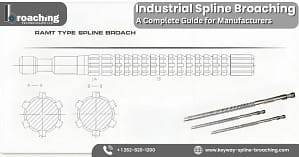
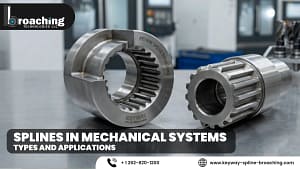
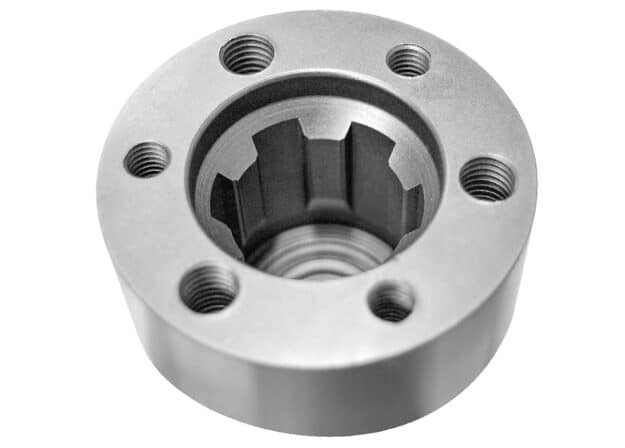
Gearbox splines require extremely precise profiles to ensure smooth gear engagement. Automotive broaching keyways often accompany spline cutting, providing a secure locking mechanism for gears on the shaft. Broached splines and keyways work together to transmit power efficiently while minimizing wear.
- Uniform spline spacing improves load distribution
- Accurate keyways prevent gear slippage
- Smooth surfaces reduce friction and heat buildup
Keyways for High-Performance Applications
Modern vehicles, especially electric and hybrid models, require keyways that can handle higher torque and rotational speeds. Broaching enables the production of keyways that meet these rigorous demands while maintaining dimensional stability. Advanced broaching techniques allow manufacturers to cut keyways in challenging materials such as hardened steel or aluminum alloys without compromising accuracy.
Advantages of Automotive Broaching Keyways
High Precision and Tolerance Control
One of the most significant advantages of automotive broaching keyways is the ability to maintain extremely tight tolerances. This precision is critical in powertrain components, where even minor deviations can result in noise, vibration, or reduced efficiency. Broaching provides a repeatable, controlled process, ensuring that every keyway meets exacting specifications.
Enhanced Durability and Reliability
Broached keyways reduce stress concentrations and surface imperfections that could lead to component failure. Shafts, gears, and couplings manufactured with high-precision broaching exhibit improved durability, reduced maintenance requirements, and longer service life.
- Reduced friction and wear on mating parts
- Minimized risk of mechanical failure under high load
- Improved performance in demanding automotive environments
Efficiency in Mass Production
Automotive manufacturers benefit from broaching’s efficiency, especially in high-volume production. Broaching can produce complex internal profiles in a single pass, eliminating the need for multiple machining operations. This reduces production time, lowers manufacturing costs, and ensures consistent quality across large production runs.
Compatibility with Various Materials
Broaching is versatile and can be applied to a wide range of automotive materials:
- Hardened steels: Common for shafts and gearbox components, providing high strength and wear resistance.
- Aluminum alloys: Lightweight components can be broached without compromising structural integrity.
- Titanium and specialty alloys: For high-performance or aerospace-inspired automotive designs.
This flexibility allows engineers to select materials that balance performance, weight, and cost without sacrificing precision.
Business Value of Automotive Broaching Keyways
Reliability Leads to Reduced Maintenance Costs
Vehicles with accurately broached keyways experience fewer drivetrain failures. Reduced wear and tear on shafts and gearboxes translate into lower maintenance costs, fewer warranty claims, and improved customer satisfaction. For fleet operators and commercial automotive buyers, this reliability is a key factor in reducing total cost of ownership.
Competitive Advantage for Manufacturers and Buyers
Investing in automotive broaching keyways delivers tangible benefits for both manufacturers and buyers:
- Faster Production Cycles: Single-pass broaching reduces machining time.
- Lower Operational Costs: Minimized scrap and rework rates improve profitability.
- Enhanced Performance: Precise keyways ensure smooth torque transfer, reducing vibration and noise.
Automotive buyers benefit from vehicles that perform reliably under diverse conditions, enhancing brand reputation and customer loyalty.
Future Trends in Broaching for Automotive Keyways
Automation and CNC Broaching
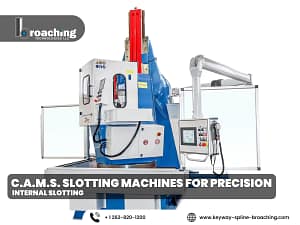
Modern broaching systems incorporate CNC technology to further improve precision, flexibility, and production speed. Automated broaching lines reduce human error, increase throughput, and allow manufacturers to produce complex keyway geometries with minimal setup time.
Advanced Materials and Coatings
As automotive materials evolve, broaching processes are being adapted to work with advanced alloys and surface treatments. Coated broaches and optimized cutting strategies enable manufacturers to maintain high precision even in harder or coated materials, ensuring durability and efficiency.
Integration with Other Powertrain Components
Future drivetrain designs may require keyways integrated with splines, grooves, and other critical features. Broaching technology is evolving to meet these requirements, offering multi-feature broaches that can cut keyways and splines in a single operation, further improving production efficiency.
Conclusion – Automotive Broaching Keyways as a Powertrain Essential
In today’s competitive automotive industry, precision and reliability are paramount. Automotive broaching keyways play a vital role in enhancing power transmission by delivering accurately machined shafts, splines, and gear interfaces. The benefits are clear: improved torque transfer, reduced wear, enhanced durability, and lower production costs.
Drivetrain engineers and automotive buyers alike can recognize the value of incorporating broaching into manufacturing workflows. High-precision keyways not only optimize component performance but also increase vehicle reliability, reduce maintenance, and ensure long-term customer satisfaction.
As vehicles continue to evolve, with higher torque requirements and advanced materials, broaching will remain indispensable. By embracing automotive broaching keyways, manufacturers and buyers can achieve a competitive advantage, delivering vehicles that meet the highest standards of efficiency, performance, and reliability.
Contact us today to learn how our broaching solutions can optimize your powertrain components and enhance drivetrain performance.