If you’re in the manufacturing business, you already know how much precision matters. If we make a wrong cut, then the whole part gets scrapped. The spline broaching process has been solving this problem for decades and quite frankly, it is one of the most underrated machining processes in the industry. It’s quick and reliable, and once you get the hang of it you’ll see why so many shops count on it for internal splines.
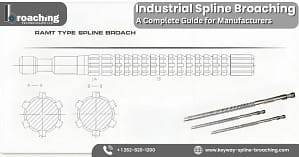
The cutting tool used in spline broaching is a broach that is multi-tooth. Each individual tooth of the tool is bigger than the previous one. The tool removes a small volume of material with each tooth as it moves through the workpiece until the complete profile of the spline is formed. This is all. Single run. Done. Most cases do not require a second operation to be performed. In high-volume production environments, where cycle time and consistency are critical, this is important more than most people realize.
What Exactly Is a Spline and Why Does It Need Broaching?
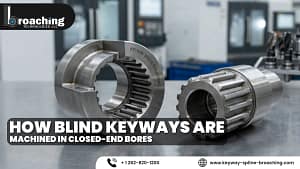
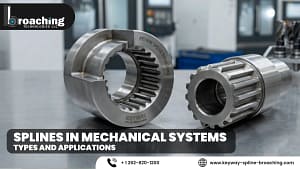
A spline is a series of ridges or teeth located on or in a bore or shaft. These ridges work together with another component to transfer rotational forces, engineers call these torques. You will find splines in gearboxes, drive shafts, steering columns, hydraulic pumps, and dozens of other assemblies that need to spin together reliably.
At this point, you could attempt to produce the internal spline through milling or EDM. Some shops do. But these methods are slow and expensive when you are making hundreds or thousands of parts. The spline broaching process cuts the entire profile in one stroke. That speed advantage, combined with excellent dimensional consistency, is why broaching became the industry standard for this type of work.
Three main spline types are commonly produced through broaching. Involute splines are the most common and show up in transmissions and industrial gearboxes constantly. Straight-sided splines handle heavier loads. Serrated splines are used in fine-pitch applications where the angular position between two parts has to be exact.
How the Spline Broaching Process Actually Works
A lot of people hear the word broaching and assume it is complicated. It is not. The logic behind it is actually quite simple once you see it broken down.
Pilot Hole First
Before any broaching happens, the workpiece needs a pre-drilled hole. The broach starts from that hole and works outward. The size of the pilot hole is calculated based on the spline dimensions you need to hit.
Tool Selection
Choosing the right broach matters enormously. You need to account for the spline type, number of teeth, pitch, material hardness, and the tolerances your drawing calls out. High-speed steel is what most broaches are made of. Carbide-tipped tools are employed for tougher materials.
Setup and Alignment
This stage divides good broaching from bad broaching. An improperly aligned tool on entry to the bore will result in chatter and poor surface finish, and the tool will break. A rigid machine and proper fixturing is essential here.
The Cut
The broach moves through the workpiece in a single controlled stroke. On vertical machines it moves downward. On horizontal machines the motion is lateral. Each tooth takes a tiny chip. By the time the last tooth exits the part, you have a finished spline.
Inspection
After the cut, the part gets checked. Common are gauges, CMM equipment, go/no-go fixtures. Generally, the component is prepared to be sent or progressed to the subsequent assembly level. No grinding. No extra finishing. Just a clean, accurate spline.
Why Manufacturers Trust the Spline Broaching Process
There are a few machining operations where the advantages are so obvious that the industry just keeps using them generation after generation. Broaching is one of them. Speed is the first reason. A broaching stroke takes seconds. When you are running a production line and need to produce five hundred identical splined hubs in a shift, that matters enormously.
Repeatability is the second reason. The profile is locked into the tool geometry. Every part comes out the same. There is no variation from operator skill or machine drift affecting your spline dimensions in the way other processes allow.
Surface finish is another big one. Broaching produces a smooth, accurate surface that usually needs no secondary work. Compare that to milling, where you often need to come back and finish the surface before the part meets spec.
Cost per part drops fast once the setup is dialed in. The operator does not need to babysit the machine. Parts move quickly. Tooling lasts a long time with proper care. Keyway Spline Broaching handles involute, straight-sided, and serrated internal spline profiles with the kind of consistency that high-volume customers expect.
Industries That Use the Spline Broaching Process Every Day
This process shows up in more industries than most people expect. The automobile industry is quite evident. Transmission gears, differential housings, drive shafts and the steering components all require internal splines with tight tolerances. A vehicle transmission alone can contain multiple broached spline interfaces.
Aerospace is another major user. Flight control actuators, landing gear assemblies, and turbine engine components all demand splines that are accurate to very tight tolerances. There is zero room for error when the part is flying at 35,000 feet.
Agricultural and construction equipment suffer from brutal punishment. Constructed heavy-duty splined connections on tractors, combines, excavators and loaders must survive shock loads and continuous vibration.Broaching produces the kind of surface hardness and profile accuracy these applications require.
Hydraulic equipment uses splines in pumps and motor shafts constantly. The fits are tight. The clearances are small. The spline broaching process is one of the few methods that can hit those tolerances reliably without a lot of extra work.
Defense and military contracts add their own layer of documentation requirements on top of the dimensional specs. Broaching fits well into controlled manufacturing environments where traceability and repeatability are audited closely.
Picking the Right Machine for the Job
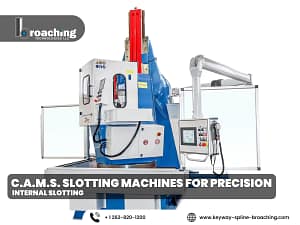
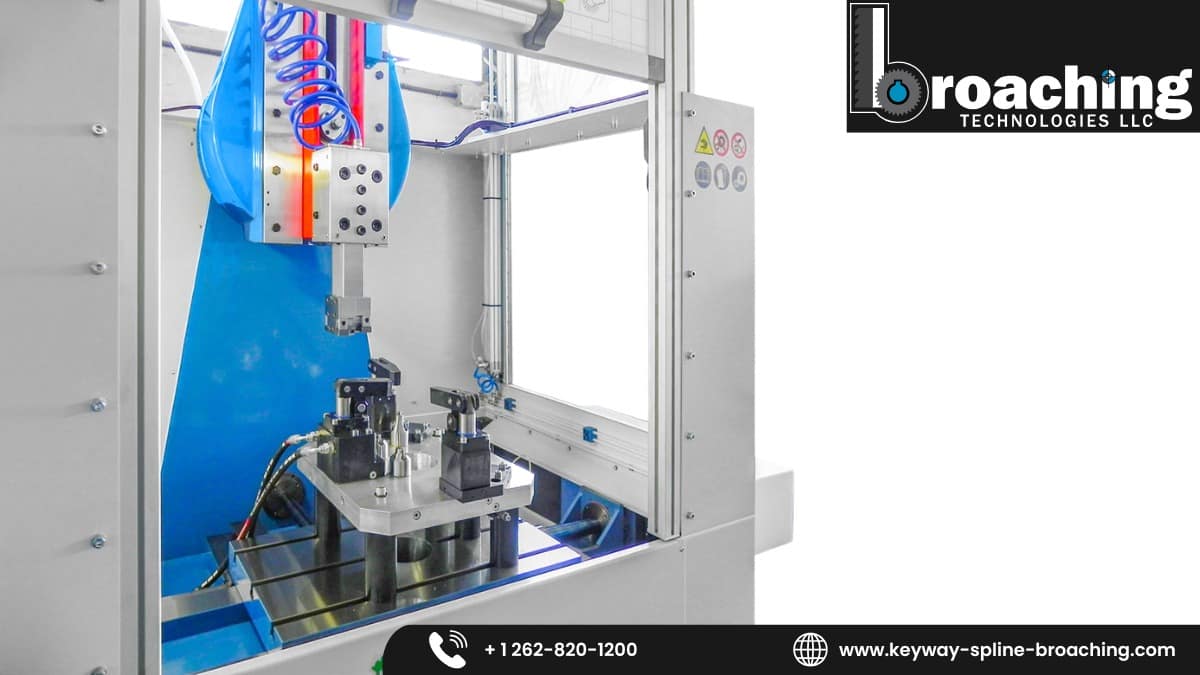
The machine matters as much as the tool. An underpowered or worn-out broaching machine will cause problems no matter how good the tooling is. Modern vertical slotting machines have become a popular complement to dedicated broaching equipment in job shops. They offer programmable stroke control, electronic feed adjustment, and multi-axis capability that older equipment simply cannot match. For shops that want flexibility across different part geometries, this type of machine gives you options.
The C.A.M.S. slotting machine lineup, exclusively distributed across North America by Keyway Spline Broaching, covers everything from compact units for smaller parts up to the Model 850 for oilfield and aerospace-scale work. These machines are built in Italy and carry a reputation for precision and durability that production shops respect.
Not every manufacturer needs to own broaching equipment though. Contract broaching is a practical path for shops that need spline work done but cannot justify the capital investment. According to the Society of Manufacturing Engineers, broaching consistently ranks among the most cost-effective methods for internal profile machining at medium to high production volumes, largely because of its single-stroke cutting capability.
Problems That Come Up and How to Handle Them
No process is perfect. Broaching has its own set of issues that come up in real production environments. Tool wear is the most common one. HSS broaches lose their edge over time, especially when cutting hardened steel. Regular re-sharpening keeps the profile accurate and prevents scrapped parts. Ignoring tool condition is how you end up with a pile of out-of-tolerance parts at the end of a shift.
Chatter is usually a fixturing problem. If the part is not clamped solidly, the broach will vibrate during the stroke and leave marks on the spline surface. Fix the setup first before assuming the tool is the issue.
Chip evacuation is critical. If chips pack into the gullets between broach teeth, they get dragged back through the bore and scratch the surface. Good coolant flow and the right lubricant for the material solve this most of the time.
Tolerance drift over long runs is real. Wear accumulates gradually. Checking a part every fifty or hundred cycles catches drift early before it becomes a scrap problem.
Conclusion
The spline broaching procedure isn’t flashy. It does not receive as much focus as multi-axis CNC machining or additive manufacturing. It has survived in production environments for over a century, but it works. Internal spline profiles can be broached faster, more accurately and with less variance from the actual profile than with any other method.
Whether you are manufacturing transmission components, hydraulic pump shafts, or aerospace actuator parts, the spline broaching process yields the kind of dimensional consistency that keeps assemblies running reliably for years. If you’re considering your options for spline production, spline broaching is worth serious consideration. Keyway Spline Broaching has the expertise, the tooling, and the equipment to support your production needs from prototype to full-scale manufacturing. The spline broaching procedure is one of the best investments a precision manufacturer can make.
Frequently Asked Questions
Q1: What is the spline broaching process?
A broaching is a single stroke machining process in which a multi-tooth broach tool cuts a complete internal spline profile in one pass through the work piece.
Q2: What materials work with spline broaching?
Steel, aluminum, brass, cast iron, and most engineering alloys can be broached without issue.
Q3: How tight are the tolerances?
Very tight. Broaching can hold tolerances within a few microns consistently across large production runs.
Q4: Is broaching cost-effective for small runs?
It works best at medium to high volumes, but contract broaching services make smaller runs viable without upfront tooling investment.
Q5: How long does a broach tool last?
Depending on the material and how well the tool is maintained, a single broach can produce thousands of parts before needing re-sharpening.